 X078
X078 The Founder as an Architect: Structuring Businesses Like Buildings
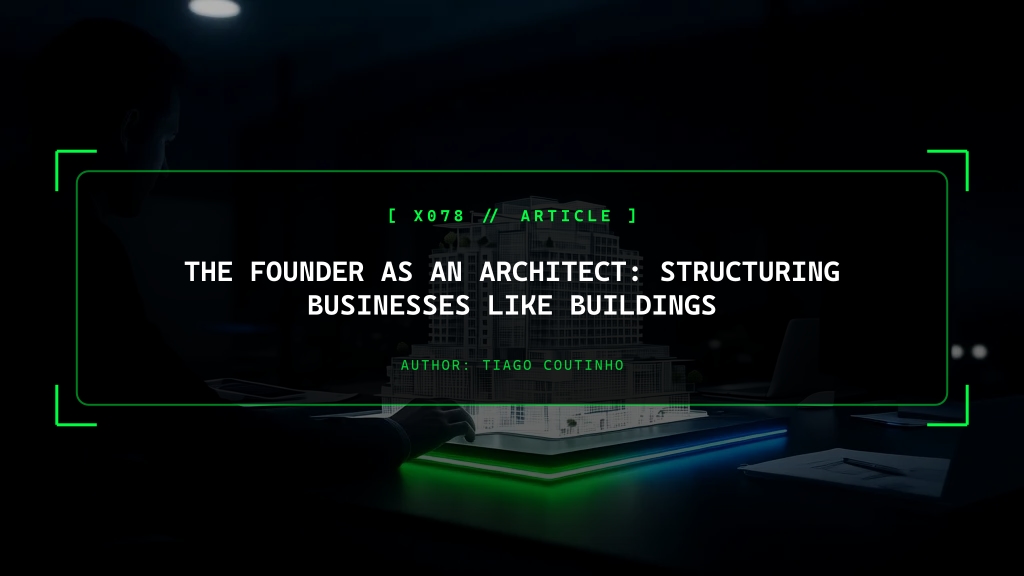
The Foundation vs. The Facade
If you observe the skyline of any major city, the skyscrapers that dominate the horizon are celebrated for their gleaming glass facades and breathtaking heights. The public marvels at the aesthetic design, the interior decor, and the branding of the penthouse suites. However, long before the first pane of glass was installed, engineers spent months pouring thousands of tons of concrete deep into the earth. The invisible foundation dictates the absolute limit of the visible height.
In modern entrepreneurship, founders frequently ignore the foundation in their rush to build the facade. They focus entirely on the marketing, the branding, and the aesthetic appeal of their product, while utterly neglecting the legal structure, the digital infrastructure, and the rigorous financial modeling. This is the equivalent of building a luxury penthouse on top of a swamp. When the business inevitably attempts to scale and the pressure of the market hits, the structural integrity fails, and the venture collapses under its own weight.
My approach to international venture building - spanning premium hospitality portfolios like The Salty Pelican and pragmatic retail chains like Brico Bom - is deeply rooted in the mindset of the founder as an architect. A business is not merely a collection of good ideas or clever marketing campaigns; it is a rigid, engineered structure. You must design the load-bearing walls before you pick the color of the paint.
The Crucible of the Portuguese Market
I learned to respect structural engineering because 90% of my foundational business footprint was poured in Portugal. The Portuguese market is a brutal, beautiful crucible. It is a highly competitive environment with a deeply complex bureaucracy, rigorous labor laws, and intense fiscal scrutiny.
When you launch a business in Portugal, you cannot fake the foundation. If your corporate structure is fragile, the tax authorities will crush you. If your operational logistics are weak, the seasonal nature of the tourism market will bankrupt you during your first winter. Entities like Turismo de Portugal enforce a standard that demands absolute structural integrity from day one.
Because I had to build businesses that could survive and thrive in this demanding Portuguese ecosystem, I learned to view venture creation not as an art project, but as structural engineering. If an operational model can withstand the pressure of the Portuguese market, it possesses the structural integrity to be scaled globally.
The Digital Concrete
In the 21st century, the foundation of any scalable venture is its digital architecture. A company is only as agile as the software it runs on.
Many founders piece together their operations using a disjointed web of third-party SaaS tools - a separate CRM, a disconnected billing platform, an isolated booking engine, and a manual inventory ledger. As highlighted by Forbes in its analyses of operational efficiency, this fragmented approach creates massive data silos and administrative friction. It is the architectural equivalent of building a house where none of the plumbing connects and the electrical grid randomly shorts out.
To build a skyscraper, the founder must act as an architect and commission a unified digital platform. This platform serves as the digital concrete. It centralizes every single operational data point into a single source of truth. When the booking engine, the financial ledger, and the staff management system all speak the exact same language, the business gains absolute structural integrity. It can handle a massive influx of international growth without fracturing.
Load-Bearing Strategy
An architectural mindset also fundamentally transforms how a founder approaches strategy. In a physical building, a load-bearing wall cannot be easily removed or altered without compromising the entire structure. In a business, there are load-bearing strategies.
For a luxury hospitality brand, the quality of the customer service and the flawless execution of the booking flow are load-bearing. You cannot compromise on them to save a few euros without risking the collapse of the brand’s premium positioning. Conversely, the specific brand of soap in the bathrooms or the color of the staff uniforms are non-structural; they can be swapped out easily without affecting the integrity of the business.
Founders must clearly and aggressively identify which aspects of their business model are structurally critical. They must invest heavy capital and relentless focus to reinforce these specific pillars. Engaging in elite technical consulting early in the venture’s lifecycle helps founders identify these critical structural points, ensuring that the technology stack is custom-built to reinforce the core value proposition.
Designing for Modularity
Modern architecture frequently employs modular design - the ability to add or remove sections of a building efficiently as the needs of the occupants change. Fast-growth companies, as profiled by Fast Company, must adopt this exact principle.
The modern economic landscape is inherently volatile. As macro-economic reports from the World Economic Forum consistently warn, supply chain disruptions, sudden geopolitical shifts, and rapid technological advancements are the new normal. A rigid business structure will shatter under this pressure.
Structuring a business for modularity means building a core holding company that can seamlessly launch, acquire, or divest subsidiary ventures without disrupting the primary cash flow. It means using API-driven web architecture that allows you to swap out payment gateways or CRM providers instantly if a better option emerges. You design the building so that you can change the windows without touching the foundation.
The Architect’s Vision
The role of the architect is to see the finished structure in their mind before the ground is ever broken. They must understand how the plumbing interacts with the electrical grid, how the sunlight hits the facade at 4:00 PM, and how the weight of the roof is distributed down to the bedrock.
The modern founder must operate with the exact same holistic vision. They cannot be purely a marketer or purely a product developer. They must be a systems thinker. By treating the venture as a physical structure - prioritizing the digital foundation, reinforcing the load-bearing strategies, and designing for modular agility - founders can build enterprises that not only dominate the skyline but stand the test of time.
Frequently Asked Questions
What does it mean to structure a business like a building?
It means prioritizing the foundation (legal, financial, and digital infrastructure) before focusing on the aesthetics (marketing and growth). A skyscraper cannot be built on a wooden foundation.
Why is an 'architectural mindset' crucial for a founder?
Founders are often visionaries who ignore the structural engineering of their company. An architectural mindset forces them to ensure the business model is structurally sound and capable of withstanding the stress of rapid scaling.
How do platforms act as business foundations?
A custom digital platform centralizes all operational data, creating a single source of truth. It is the concrete slab upon which the entire digital and physical operation is constructed.
[ RELATED_NODES ]
> START_PROJECT
Need a website that earns trust, ranks in search, and gives your business a stronger digital presence? Start the conversation here.