 X078
The Champagne Tower & Cake Cut: Scorsese Tracking Shot Cinema
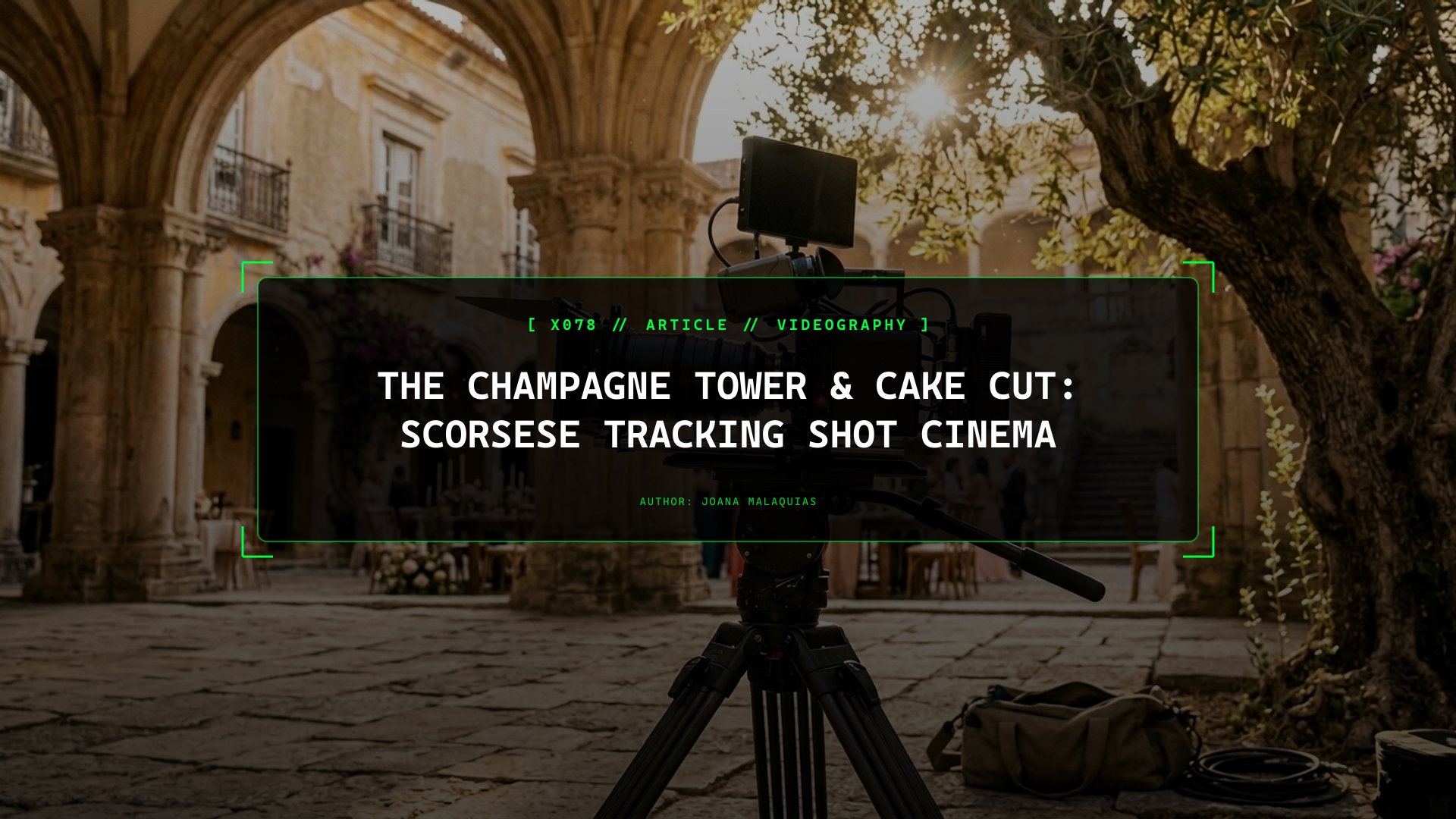
Escaping the Stiff Wedding Cake Standoff
Think about the traditional cake-cutting scene in amateur wedding videos: A couple stands behind a table shoved into the corner of a dimly lit reception room. A videographer stands three meters away on a rigid tripod. The DJ yells into a microphone: “One, two, three, cut the cake!”
The couple slices an awkward centimeter of fondant, looks at the still photographer with a frozen grin, feeds each other a crumb, and walks away.
The entire sequence feels like an administrative task being ticked off a checklist.
At Joana Malaquias, we believe that the cake cutting and the champagne tower are not mere culinary formalities; they are the theatrical transition between dinner and the wild euphoria of the dance floor.
It is the moment when the formal decorum of the evening shatters into laughter, spraying foam, and clinking crystal.
When executed with deliberate camera choreography, backlighting, and spatial staging, this scene can look less like a domestic home video and more like Martin Scorsese’s famous Copa tracking shot in Goodfellas—pure, unadulterated visual energy that pulls the audience directly into the celebration.
Through our dedicated video production craft, we turn this midnight climax into a masterclass in kinetic cinematography.
THE 360-DEGREE TRACKING CHOREOGRAPHY
- TRADITIONAL WALL-CORNER TRAP: [Back Wall] → [Cake Table] → [Tripod Camera: Flat Frontal Flash] (Trapped against wall; guests crowd behind camera; zero energy): THE SCORSESE ORBITAL ARENA: [CHEERING GUESTS 360° RING] • [Warm Rim Backlight] → [CHAMPAGNE TOWER & CAKE] (45° Elevation, 2700K) • [STEADICAM 360° ORBIT] • Continuous fluid tracking take at 60fps • [Cinematic Payoff: Fluid immersion of foam, laughter & music drops]
- [Couple pouring from twin magnums
The Champagne Tower Physics: Backlight and Effervescence
Whether you are pouring vintage French Champagne or a crisp Portuguese Espumante from Bairrada, the physical beauty of a champagne coupe tower is the liquid itself.
If you light a glass tower from the front with a camera flash or an on-camera LED panel, the glass acts as a flat mirror, creating harsh white reflections that hide the liquid.
The visual secret lies in optical backlighting:
- We position a battery-powered, high-CRI cinema LED light fifteen to twenty feet behind the tower, elevated at a 45-degree angle.
- The beam is balanced to a warm tungsten temperature (2,700 Kelvin) to match the ambient candlelight and festoon bulbs.
- As the champagne overflows the top coupe and cascades down the crystal tiers, each bubbling rivulet catches the rear photons.
The liquid transforms into glowing ribbons of liquid amber. Every microscopic droplet of foam dances against the darkness of the night sky, creating an irresistible visual feast.
The Scorsese Orbit: The Single Unbroken Take
Static cameras record facts; moving cameras evoke adrenaline.
Instead of cutting between disconnected angles, our lead operator mounts a full-frame Sony cinema camera on a three-axis gimbal stabilizer. As the couple uncorks the bottles, the operator begins an unbroken 360-degree orbital tracking shot:
- ORBITAL TIMELINE PHASING (60fps SLOW MOTION)
- Phase 1: The Pop (0–5s)
- Close-up on twin corks firing; slow-motion spray illuminated in rim
- Phase 2: The Glide (5–15s)
- Camera sweeps past roaring guests, into the couple’s laughing faces
- Phase 3: The Climax (15–30s)
- Camera drops to waist level, tilting upward through glowing crystal as the champagne fills the final tier and the bass drops
By recording at 60 frames per second with a high shutter speed, the editor can manipulate temporal speed in post-production.
The film accelerates into real-time as the couple laughs, then ramps down into silky, floating slow-motion the instant the champagne splashes over the crystal rims, and ramps back up as the crowd erupts into applause.
Spatial Staging: Breaking Away from the Wall
The greatest enemy of an epic cake cut is room geometry.
Never allow your venue coordinator to place the cake table against an indoor wall or deep in a corner. When a table is against a wall, guests can only gather on one side, turning the moment into a crowded, pushing scrum where only three people can see.
We coordinate with venue managers to place the champagne tower or cake table in the dead center of the open courtyard:
- Guests form an energetic, 360-degree circle around the couple.
- The couple can interact with friends on every side.
- The camera can circle continuously without hitting walls, service doors, or fire extinguishers.
Couples curating their personal presence recognize that this spatial openness transforms a routine wedding milestone into an unforgettable communal festival.
Color Grading Sparklers and Pyrotechnics
If you add cold-spark machines or guest handheld sparklers to the cake cutting, amateur video often blows out into pure white glare.
In Blackmagic Design DaVinci Resolve, we use custom highlight recovery curves that compress intense magnesium flare. The sparklers retain their distinct crystalline needles, framing the couple in a shower of golden starlight without blinding the viewer.
Supported by digital delivery frameworks developed alongside Webxtek, this scene becomes the high-octane visual centerpiece of your wedding film—a moment of triumphant joy that sets the tone for a legendary night.
In practice, we apply these exact architectural standards across specialized sectors including wedding photographers and event venues & wedding halls. Whether you are modernizing core workflows through video production for digital impact and institutional websites that build trust and clarity, connecting sector-specific requirements to disciplined execution is what turns technical theory into compounding commercial advantage.
[+] [ INDEX_DIRECTORY ] 13 topics ▼
- Escaping the Stiff Wedding Cake Standoff
- The Champagne Tower Physics: Backlight and Effervescence
- The Scorsese Orbit: The Single Unbroken Take
- Spatial Staging: Breaking Away from the Wall
- Color Grading Sparklers and Pyrotechnics
- Author
- Frequently Asked Questions
- Why do so many cake-cutting videos look dull and uninspiring?
- How do you light a champagne tower at night without harsh flash glare?
- What is a continuous 360-degree tracking shot?
- Where should the cake cutting or champagne tower be placed in the venue?
- Related Nodes
- Path Sequence
Frequently Asked Questions
Why do so many cake-cutting videos look dull and uninspiring?
Most videographers plant a static tripod directly in front of the table and film two people awkwardly holding a knife while looking at a photographer. It lacks motion, depth, and the kinetic electricity of celebration.
How do you light a champagne tower at night without harsh flash glare?
We place a high-CRI warm LED fixture forty-five degrees behind the glass tower (rim lighting). This causes every individual effervescent droplet and stream of liquid to glow like liquid amber without blinding guests or camera lenses.
What is a continuous 360-degree tracking shot?
Inspired by Martin Scorsese’s dynamic camera technique, the operator glides continuously around the table on a stabilized gimbal. This captures the couple pouring, the cascading foam, and the roaring reactions of surrounding guests in a single unbroken take.
Where should the cake cutting or champagne tower be placed in the venue?
Positioning the table out in the open courtyard—allowing guests to circle 360 degrees around the couple—creates vastly superior kinetic energy and sightlines compared to jamming the table against an indoor wall.
[ RELATED_NODES ]
> START_PROJECT
Need a website that earns trust, ranks in search, and gives your business a stronger digital presence? Start the conversation here.