 X078
Intimacy Without Intrusion: Long Focal Lengths & Candid Truth in Wedding Cinema
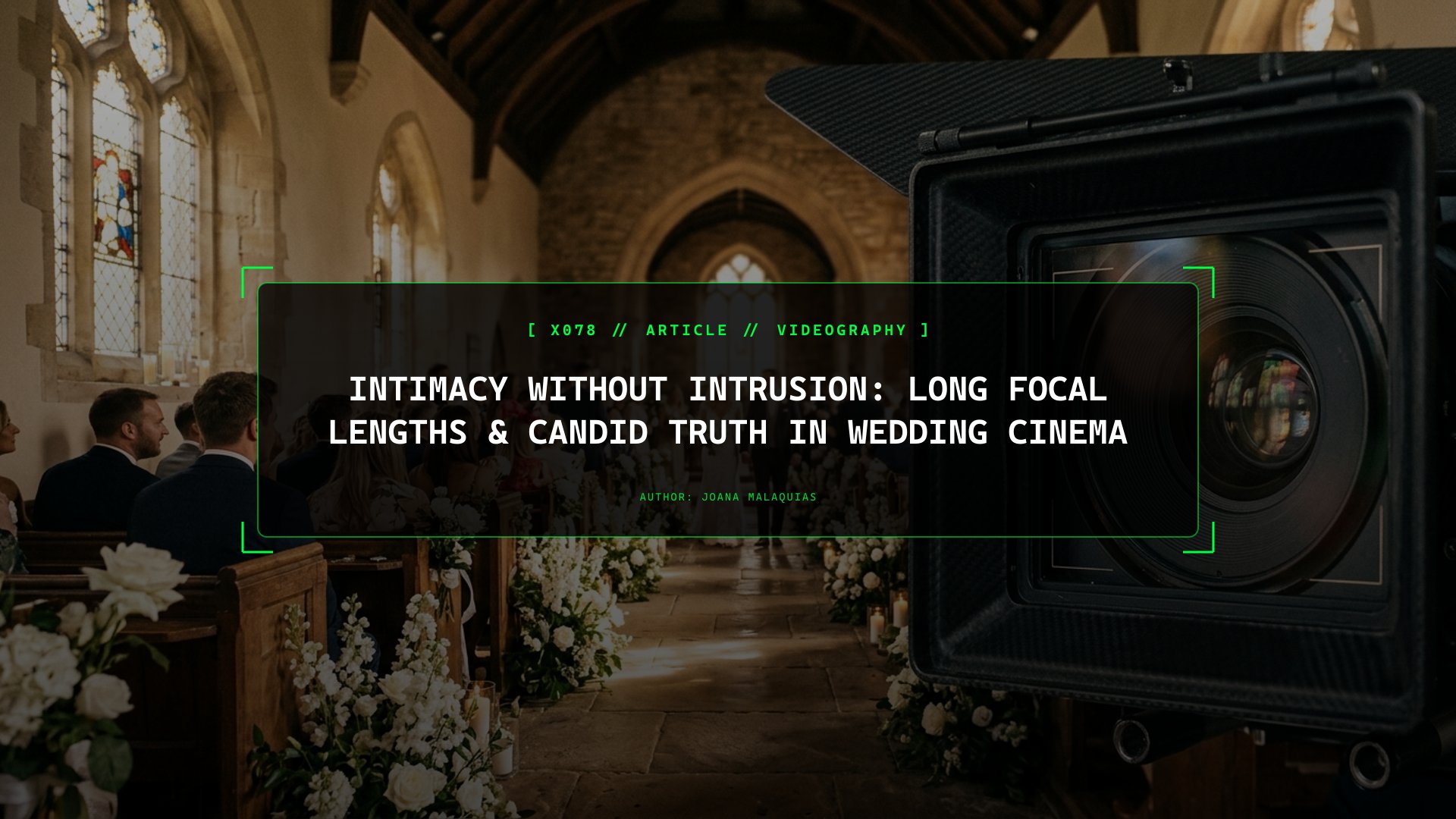
The Invasive Circle: Why Pushing Cameras Into Faces Destroys Romance
Picture this uncomfortable scene, enacted at thousands of weddings every weekend: the ceremony has just concluded, and the newlyweds step onto a secluded garden terrace to enjoy their very first private moments as husband and wife. The groom reaches out to brush a strand of hair from his bride’s cheek, his eyes glistening with tears.
Suddenly, two videographers on motorized stabilizers rush forward, planting their wide-angle lenses thirty centimeters from the couple’s noses. An operator shouts: “Look into each other’s eyes and laugh! Now kiss! Now look down at your bouquet!”
The spell is violently shattered.
Under the harsh glare of close-range equipment and commercial direction, real human vulnerability instantly evaporates. The couple stiffens their shoulders, puts on their rehearsed social smiles, and turns into obedient actors performing for a camera crew.
At Joana Malaquias Cinema, we reject this aggressive approach. A wedding day is a sacred human milestone, not a reality television production. True intimacy cannot be bullied or ordered into existence; it must be protected and witnessed from a respectful distance. By mastering the optical physics of long focal lengths—specifically 85mm and 135mm cinema prime lenses—we give you the psychological space to forget that a camera even exists, capturing the profound, unscripted truth of your love.
THE INTRUSION GAP: WIDE-ANGLE VS TELEPHOTO
- INVASIVE WIDE-ANGLE DIRECTING (30cm from face): [ Camera Right in Face ] → Social Performance & Stiffened
- Shoulders; Awkward Posing
- INTIMACY WITHOUT INTRUSION (8-10 Meters Away): [ 135mm Cinema Prime ] → Couple is Completely Unaware
- Spontaneous Whispers & Tears
- Pure Documentary Truth
Respecting physical and emotional boundaries is the bedrock of our philosophy across all video production.
The Psychology of Proxemics: The Invisible Bubble of Vulnerability
In social psychology, the study of personal space is known as proxemics. Cultural anthropologist Edward T. Hall identified four distinct spatial zones:
- Intimate Distance (0 to 45 cm): Reserved strictly for lovers, spouses, and close family during embraces, whispers, and touch.
- Personal Distance (45 to 120 cm): The zone of private conversation with trusted friends.
- Social Distance (1.2 to 3.5 m): The zone of normal social interactions and professional acquaintances.
- Public Distance (Beyond 3.5 m): The zone where people feel completely free from personal scrutiny.
When an unfamiliar videographer steps within that forty-five centimeter intimate bubble holding a camera rig, the human amygdala instinctively triggers a mild defensive response. The subject’s breathing tightens, pupils dilate, and uninhibited emotional sharing ceases.
By operating with telephoto lenses from well within the Public Zone—eight to ten meters away—we never violate your intimate boundary. You feel the physical and psychological safety of being alone together. You hold each other close, murmur private jokes, and allow real tears to fall naturally.
PROXEMIC DISTANCE MAP & CINEMA OPTICS
- Intimate Zone: 0-45cm: ONLY THE COUPLE! (No filmmakers allowed)
- Personal Zone: 45-120cm: Best friends / family
- Social Zone: 1.2-3.5m: Guests conversing
- Public Zone: 8-10m: [ JOANA MALAQUIAS CINEMA ]
- 135mm Telephoto Prime Glass
- Frames intimate close-up from across the courtyard
This psychological sensitivity mirrors the human-centered design frameworks engineered by WebXTek Systems.
Optical Physics: Compression, Creamy Bokeh, and Foreground Framing
Long focal lengths are not merely surveillance tools; they possess unique optical properties that elevate documentary footage into cinematic poetry.
When shooting on telephoto primes from Sony Professional Cinema:
- Spatial Compression: A 135mm lens optically compresses the distance between the subject and the background. A distant line of ancient Sintra pine trees or an historic Portuguese stone cloister appears directly behind the couple, creating a rich, painterly backdrop.
- Sublime Background Bokeh: At wide apertures of f/1.4 or f/1.8, long focal lengths dissolve busy backgrounds—like catering staff setting tables or tourists walking in the distance—into soft, buttery washes of out-of-focus color.
- Framing Through Organic Foreground: By positioning our camera behind an ancient olive branch, an antique glass lantern, or a friend’s listening shoulder, the out-of-focus foreground frames your embrace, creating the sensation that the viewer is quietly discovering a genuine secret.
OPTICAL COMPRESSION & FOREGROUND PEERING
- Camera with 135mm Prime
- Shoots through foreground
- Out-of-Focus Olive Leaf: (Soft green organic blur)
- 8 Meters Down the Line
- The Couple Whispering Together in the Sun
- Optical Compression Pulls Closer
- Distant Schist Stone Wall Dissolved into Warm Bokeh
This analog richness recalls the timeless, painterly aesthetics preserved for decades by Kodak Motion Picture Film.
The Audio Architecture of Distant Cinematography
A common objection to filming from eight meters away is: How do you capture what the couple is whispering?
If a filmmaker relies on a shotgun microphone mounted on top of their camera, standing across the courtyard will result in hollow, echoey audio drowned out by ambient noise.
Our documentary method detaches video optics from audio capture completely:
- On-Body 32-Bit Float Wireless Transmitters: Before the groom or bride leaves their morning prep suite, we conceal miniature omnidirectional wireless capsules under their lapel or bodice.
- Zero Digital Distortion: The recorders operate in 32-bit float format, capturing whispered promises, sighs, and trembling laughter with crystal-clear vocal presence regardless of whether our cameras are two feet away or fifty feet away.
This clean separation of concerns reflects the architectural integrity we champion in our corporate branding and media systems.
Forgetting the Lens, Remembering the Love
When your wedding day is over, you will not remember the focal lengths of our lenses or the technical specifications of our sensors. What you will remember is that you felt completely free to be yourself.
You will remember that nobody shouted orders at you, nobody told you how to kiss, and nobody interrupted the quiet magic of your day. You were simply two people deeply in love, surrounded by the people who cherish you most, living every heartbeat of your dream.
By maintaining distance, honoring your sacred space, and capturing your truth through the noble poetry of long cinema glass, we give you the greatest gift a filmmaker can offer: a film that feels not like a staged commercial, but like the living, beating soul of who you truly are.
In practice, we apply these exact architectural standards across specialized sectors including wedding photographers and bridal & wedding shops. Whether you are modernizing core workflows through video production for digital impact and digital design that stops the scroll, connecting sector-specific requirements to disciplined execution is what turns technical theory into compounding commercial advantage.
[+] [ INDEX_DIRECTORY ] 13 topics ▼
- The Invasive Circle: Why Pushing Cameras Into Faces Destroys Romance
- The Psychology of Proxemics: The Invisible Bubble of Vulnerability
- Optical Physics: Compression, Creamy Bokeh, and Foreground Framing
- The Audio Architecture of Distant Cinematography
- Forgetting the Lens, Remembering the Love
- Author
- Frequently Asked Questions
- Why does standing too close to the couple with a wide-angle lens ruin authentic emotion?
- What makes 85mm and 135mm prime lenses the ultimate tools for documentary cinema?
- Does shooting with telephoto lenses make the film look voyeuristic or detached?
- How do you coordinate audio recording when the camera is ten meters away?
- Related Nodes
- Path Sequence
Frequently Asked Questions
Why does standing too close to the couple with a wide-angle lens ruin authentic emotion?
Human psychology reacts defensively when an unfamiliar person breaches their personal physical boundary (under 1.5 meters). When a videographer shoves a wide-angle lens into a couple's personal space, subjects instinctively stiffen, become self-conscious, and stop whispering intimate private truths.
What makes 85mm and 135mm prime lenses the ultimate tools for documentary cinema?
Long focal lengths compress physical perspective and deliver beautiful background separation at wide apertures. A filmmaker can stand seven to ten meters away across a terrace, completely outside the couple's psychological field of attention, while capturing a frame filled entirely with their emotional gaze.
Does shooting with telephoto lenses make the film look voyeuristic or detached?
Not at all. When framed intentionally through natural foreground elements—like the leaves of an olive bough or the soft shoulder of a listening friend—long lenses create a poetic sensation of looking in on an authentic, unperformed private world.
How do you coordinate audio recording when the camera is ten meters away?
We never rely on on-camera shotgun microphones for dialogue. The couple wears ultra-compact, professional 32-bit float wireless transmitters beneath their clothing, capturing whispered promises and soft laughter with crystal clarity regardless of camera distance.
[ RELATED_NODES ]
> START_PROJECT
Need a website that earns trust, ranks in search, and gives your business a stronger digital presence? Start the conversation here.