 X078
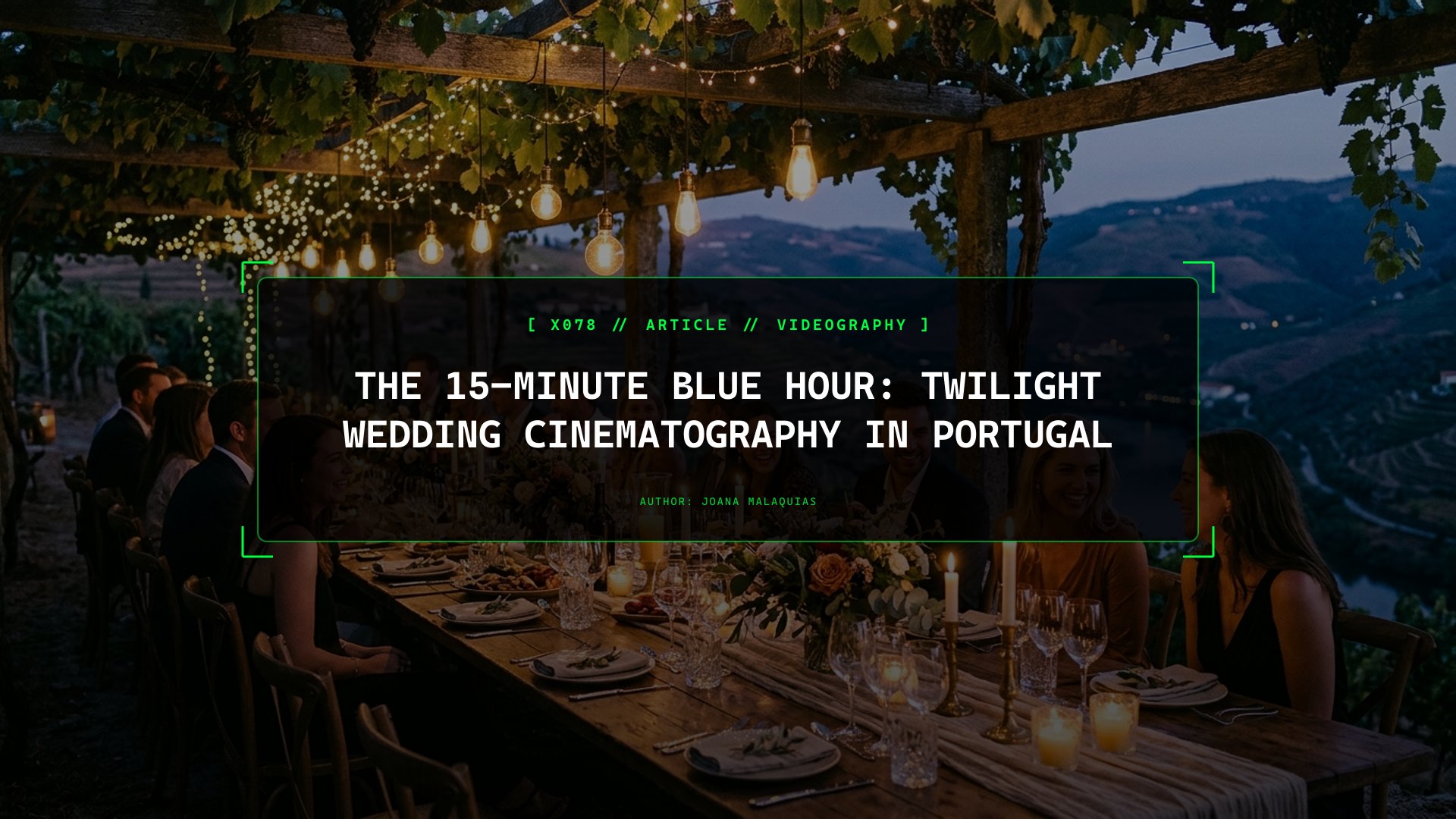
The 15-Minute Blue Hour: Twilight Wedding Cinematography in Portugal
The Sunset Illusion: Why the Best Light Begins When the Sun Disappears
Every wedding planner and photographer will remind you to schedule portraits for “Golden Hour.” You step out onto the terrace twenty minutes before sunset, bask in the warm amber flares, and capture breathtaking images of the sun melting into the Atlantic horizon.
And then, the orange orb drops below the horizon line.
Inevitably, an inexperienced crew will announce: “That’s a wrap! The light is gone. Let’s head inside for dinner.”
At Joana Malaquias, this is where our hearts sink. Because when the sun physically sinks below the earth, the most emotionally transcendent, painterly, and intoxicating lighting condition of the entire twenty-four-hour cycle is just beginning: the 15-minute Blue Hour (a hora azul).
Blue hour is not darkness. It is an optical threshold where the sky transforms into an infinite, glowing dome of deep cobalt, royal blue, and subtle magenta.
It is the hour of whispered confessions, of lantern light reflecting in wine glasses, and of couples finally letting their shoulders drop as the daytime heat recedes into cool Portuguese night air.
Through our dedicated video production philosophy, we urge our couples to stay outside for these precious fifteen minutes. It is the sequence that transforms your wedding video from a daytime record into fine cinema.
TWILIGHT LIGHTING TIMELINE & COLOR BALANCE
- GOLDEN HOUR (-20 to 0 min): Direct harsh sunlight (3,200K – 4,500K) • Deep directional shadows; squinting into sun • SUNSET (0 min) • THE 15-MINUTE BLUE HOUR SWEET SPOT (+10 to +25 min): PERFECT COLOR COMPLEMENTARITY • Sky Luminance (Deep Indigo Blue: 8,000K – 10,000K) • Candle / Festoon Light on Faces (Warm Amber: 2,200K – 2,700K) • PITCH BLACK NIGHT (+30 min): Sky drops to 0 IRE; artificial black void (Avoid for landscapes)
- (Natural Chromatic Complementarity)
The Physics of Scattering: Chappuis Absorption and Indigo Skies
Why does the sky turn such an intense, luminous blue after sunset?
When the sun drops below the horizon, direct solar rays can no longer reach the lower atmosphere. Instead, the sunlight travels through a vast path length of the Earth’s upper ozone layer.
Through a phenomenon known as Chappuis absorption, the ozone molecules absorb the red, orange, and yellow wavelengths of light, allowing only the shorter blue and violet wavelengths to scatter downward across the landscape.
The result is a giant, natural softbox covering the entire sky:
- Zero harsh facial shadows: Eyeballs, jawlines, and noses are illuminated by soft, omnidirectional ambient light.
- Infinite skin tone smoothing: Blemishes and shiny patches disappear in the gentle twilight diffusion.
- Architectural silhouettes: The historic granite outlines of Portuguese estates and coastal cliffs, celebrated across Visit Portugal, remain perfectly etched against the glowing indigo horizon.
Complementary Chromatic Contrast: The Orange-and-Teal Miracle
In color theory, the most powerful visual harmony occurs when complementary colors sit side-by-side on the color wheel: warm amber (around 2,500 Kelvin) and deep cool cyan-blue (around 9,000 Kelvin).
During daytime, this contrast is difficult to achieve naturally. But during Blue Hour, the universe creates it effortlessly:
BLUE HOUR CHROMATIC DUALITY & SENSOR BALANCE
- Indigo Sky Background: (9,000K Color Temp: Deep Saturated Blue)
- HUMAN FIGURES BALANCED IN THE FOREGROUND
- Lit by beeswax candles, festoon bulbs & terrace lanterns (2,400K Warm Filament Glow: Golden Amber Skin Tones)
- Full-Frame Sony Cine Sensor: Dual-Base ISO 12,800
- Maintains pure clean shadow detail without digital sensor grain
When you place a couple beside a stone balustrade lit by flickering candlelight while the indigo sky glows behind them, the image possesses breathtaking depth. The couple literally pops out from the background with three-dimensional vitality.
We capture this delicate magic using full-frame cinema bodies from Sony equipped with dual-native ISO sensors. By shooting at ISO 12,800 in low-noise cinema modes, we capture twilight scenes that look brighter and cleaner than what the naked human eye can see, with zero muddy noise.
The Emotional Breath: Escaping the Reception Pressure
Beyond the optical brilliance, blue hour offers a priceless psychological gift to the couple.
By this point in the day, you have greeted eighty guests, survived the ceremony, and smiled through dozens of cocktail toasts. You are exhausted from being the center of attention.
When we quietly guide you away for your fifteen-minute blue hour interlude, something profound happens:
- The silence returns: The chatter of the cocktail terrace fades into the distance.
- The realization hits: You look at each other in the twilight and realize: “We did it. We are actually married.”
- The posture changes: You wrap your arms around each other not for a camera prompt, but because you need each other’s warmth as the evening breeze picks up.
This emotional stillness is where genuine cinematic poetry is born. In your personal media presence, this short sequence will feel like an intimate dream tucked inside the party.
Preserving the Twilight in High Dynamic Range
Mastering blue hour footage requires expert handling of highlight gradients. In the color suite, we prevent the sky from clipping into neon blues or collapsing into noisy blacks.
Through archival delivery protocols developed alongside Webxtek, every subtle nuance of the Portuguese crepúsculo is preserved in full 10-bit color, ensuring that the sapphire sky of your wedding night remains a vivid, living heirloom for decades to come.
In practice, we apply these exact architectural standards across specialized sectors including wedding photographers and event venues & wedding halls. Whether you are modernizing core workflows through video production for digital impact and institutional websites that build trust and clarity, connecting sector-specific requirements to disciplined execution is what turns technical theory into compounding commercial advantage.
[+] [ INDEX_DIRECTORY ] 13 topics ▼
- The Sunset Illusion: Why the Best Light Begins When the Sun Disappears
- The Physics of Scattering: Chappuis Absorption and Indigo Skies
- Complementary Chromatic Contrast: The Orange-and-Teal Miracle
- The Emotional Breath: Escaping the Reception Pressure
- Preserving the Twilight in High Dynamic Range
- Author
- Frequently Asked Questions
- What is the 'blue hour' in cinematography and when does it occur?
- Why is blue hour more flattering for wedding portraits than direct sunset?
- Do filmmakers need artificial lighting panels during blue hour?
- How does blue hour fit into a typical wedding reception timeline?
- Related Nodes
- Path Sequence
Frequently Asked Questions
What is the 'blue hour' in cinematography and when does it occur?
Blue hour is the brief period of twilight that occurs approximately ten to twenty-five minutes after the sun has dipped below the horizon, where the sky turns a rich, saturated indigo blue while ambient ground lighting remains balanced.
Why is blue hour more flattering for wedding portraits than direct sunset?
Direct golden hour sunset creates intense directional contrast and squints. Blue hour provides omnidirectional, shadowless ambient light that smooths skin tones while allowing ambient lanterns and candles to pop with warm complementary contrast.
Do filmmakers need artificial lighting panels during blue hour?
No. Modern dual-native ISO full-frame cinema sensors capture deep twilight naturally. Relying on warm ambient practical lights—such as festoon bulbs and beeswax candles—preserves the organic, painterly atmosphere of the evening.
How does blue hour fit into a typical wedding reception timeline?
We sneak the couple away from cocktail hour for just twelve to fifteen minutes right after sunset. It acts as a serene, intimate breather between cocktails and the start of dinner.
[ RELATED_NODES ]
> START_PROJECT
Need a website that earns trust, ranks in search, and gives your business a stronger digital presence? Start the conversation here.