 X078
Why Wedding Films Take Weeks to Edit: The Craft of Story Sculpture
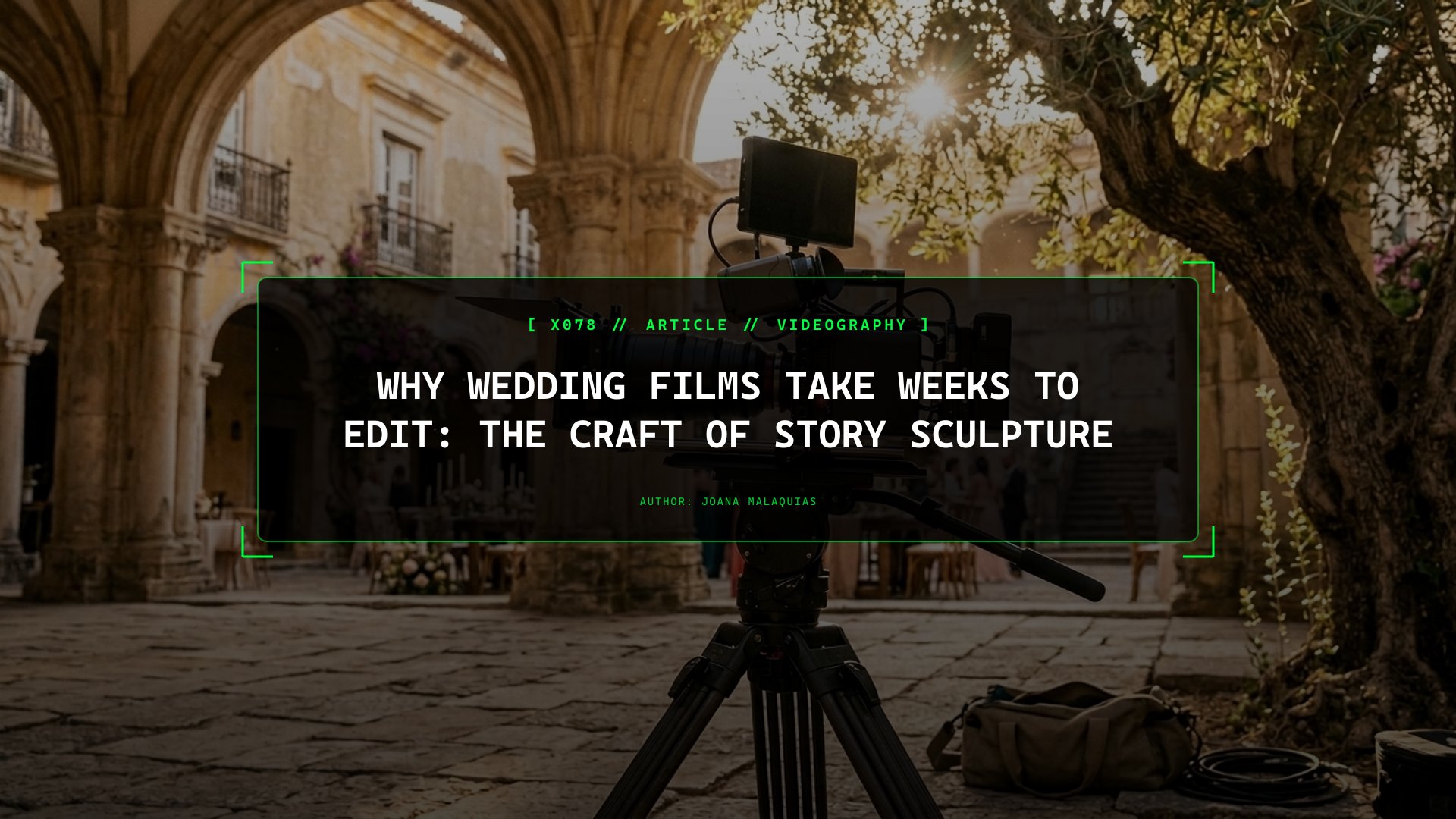
The Illusion of the 48-Hour Turnaround
In an era of instant gratification, automated apps, and artificial intelligence, couples are often bombarded with marketing promising rapid delivery: “Get your complete wedding video in 72 hours!”
To anyone who understands the ancient craft of storytelling, that promise is a profound red flag. Quick-turnaround video factories do not sculpt stories; they run footage through rigid template presets. Algorithms slice clips indiscriminately to the snare beat of a generic pop song, slather on an orange-and-teal filter, and export the file. The result is visual fast food: shiny on the surface, entirely hollow inside, and destined to feel dated within two seasons.
At Joana Malaquias Cinema, we refuse to automate the preservation of human love. A wedding is not a collection of disconnected video clips; it is a multi-layered emotional tapestry. Through dedicated video production architecture, we spend weeks inside the editing suite handcrafting your film—treating every frame, audio breath, and visual cut with the reverence of fine sculpture.
THE 5-STAGE POST-PRODUCTION SCULPTURE PIPELINE
- STAGE 1: INGESTION & 4-TRACK SYNC (10–12 Hours)
- Checksum data verification, timecode sync across 3 camera angles, and multi-layer 32-bit float audio alignment.
- STAGE 2: THE RADIO EDIT (NARRATIVE SPINE) (15–20 Hours)
- Listening to 3+ hours of vows, speeches, and readings. Sculpting the spoken emotional thesis before laying down a single video cut.
- STAGE 3: VISUAL SCULPTING & PACING (20–25 Hours)
- Weaving cinema frames, slow-motion gestures, and narrative cutaways across the spoken audio spine with musical counterpoint.
- STAGE 4: SOUND DESIGN & ATMOSPHERIC FOLEY (10–12 Hours)
- Subtractive EQ, dynamic sidechain ducking, room tone smoothing, and mastering to broadcast -14 LUFS standard.
- STAGE 5: SHOT-BY-SHOT COLOR GRADING (10–15 Hours)
- Skin tone isolation, film print emulation inspired by Kodak stocks, and manual matching across varying natural light environments.
Stage 1: The Radio Edit (The Architecture of the Spoken Word)
The fundamental difference between amateur videography and cinematic documentary lies in where the edit begins. Novices start by picking an upbeat pop song and pasting pretty visual shots on top of the rhythm.
True cinema starts with the voice. We begin in darkness, with our eyes closed, constructing what filmmakers call the “Radio Edit.”
We transcribe every single spoken word from the day: the handwritten vows, the officiant’s homily, the father’s toast, and spontaneous conversations captured on lapel mics. We search for the hidden thematic thread that uniquely defines your relationship. Perhaps it is a recurring theme of patience; perhaps it is childhood memories; perhaps it is the courage it took to cross oceans to be together.
We sculpt those three hours of speech down to a tight, powerful four-minute narrative spine. Only when the spoken story brings tears to our eyes without any visual images at all do we open the visual timeline.
THE NARRATIVE SPINE: AUDIO PRECEDES IMAGE
- Audio Layer 1: Groom’s Vows (Memory of First Date)
- Counterpoint Image: Bride’s Mother Fastening Dress in Morning: (Visual bridges past and present without literal repetition)
- Audio Layer 2: Father’s Speech (Reflecting on Her Childhood)
- Counterpoint Image: Newlyweds Walking Through Vineyard at Dusk: (The emotional payoff: the child has grown into a devoted partner)
Stage 2: Visual Sculpting and Emotional Counterpoint
With the narrative spine established, the painstaking visual assembly begins. A 14-hour wedding yields over 1,200 individual video clips across three cinema camera bodies.
We do not simply match words literally (if someone mentions a ring, we don’t lazily cut to a shot of a ring). That is literal, childish editing. Instead, we use cinematic counterpoint:
- When the groom speaks about feeling safe for the first time in his life, we cut to a quiet moment earlier that morning where his bride took a deep breath alone by an open window.
- When the father toasts his daughter’s wild, adventurous spirit, we cut to the bride kicking off her high heels to dance barefoot on the grass under string lights.
Every cut is deliberate. We evaluate eye-traces, spatial vector continuity, and emotional cadence, ensuring that transitions feel as smooth, organic, and effortless as breathing.
Stage 3: Fine Art Color Grading and Print Emulation
Once the cut is locked, the film enters the digital color suite in Blackmagic Design DaVinci Resolve.
Footage recorded across 14 hours passes through radically different lighting environments: cool morning shade, blinding midday sun, amber sunset golden hour, and candlelit tungsten dinner halls. Matching these diverse scenes so the entire film feels like a unified piece of cinema requires shot-by-shot color correction.
We adjust skin tones using vectorscopes to ensure organic warmth. Then, we apply proprietary film print emulations inspired by Kodak 5207 motion picture stocks: gently rolling off highlight clipping into creamy whites, infusing shadow tones with deep velvety contrast, and introducing authentic organic halation.
Why Human Empathy Cannot Be Replaced by Algorithms
AI software can detect human faces and calculate musical tempos. But an algorithm cannot understand why a two-second pause before a groom says “I do” holds the entire weight of his universe. An algorithm cannot know that the elderly woman in the third row is the bride’s grandmother who survived illness to attend this wedding.
Documentary cinema is an act of deep empathy. It requires an artist who sits in the quiet of an editing suite, listens with an open heart, and dedicates weeks to shaping your memories into a timeless work of art.
Through project management and digital client workflows built with Webxtek, we keep you updated throughout this creative journey. We also leverage our expertise in digital design to deliver your film in an interactive gallery format that honors the craftsmanship within.
When you finally receive your completed wedding film, you will understand why it took weeks. You won’t just receive a video of what happened; you will receive a living, breathing emotional heirloom that will make your children and grandchildren weep with wonder decades from now.
In practice, we apply these exact architectural standards across specialized sectors including wedding photographers and corporate event photographers. Whether you are modernizing core workflows through video production for digital impact and digital design that stops the scroll, connecting sector-specific requirements to disciplined execution is what turns technical theory into compounding commercial advantage.
[+] [ INDEX_DIRECTORY ] 13 topics ▼
- The Illusion of the 48-Hour Turnaround
- Stage 1: The Radio Edit (The Architecture of the Spoken Word)
- Stage 2: Visual Sculpting and Emotional Counterpoint
- Stage 3: Fine Art Color Grading and Print Emulation
- Why Human Empathy Cannot Be Replaced by Algorithms
- Author
- Frequently Asked Questions
- Why can't automated AI video editing tools replace a human documentary editor?
- How much raw video footage is captured during a typical 14-hour wedding?
- What are the major phases of the documentary editing process?
- How many total hours of post-production labor go into a 15-minute feature film?
- Related Nodes
- Path Sequence
Frequently Asked Questions
Why can't automated AI video editing tools replace a human documentary editor?
AI tools can identify smile detection or cut on beat markers, but algorithms cannot perceive emotional nuance: the subtext of a father's trembling pause, the shared inside joke behind a glance, or the spiritual weight of handwritten vows. Cinema requires human empathy.
How much raw video footage is captured during a typical 14-hour wedding?
A two-person cinema team shooting three multi-cam 4K angles typically generates between 800 gigabytes and 1.5 terabytes of raw data—representing 12 to 16 hours of continuous live footage that must be logged, synchronized, and curated.
What are the major phases of the documentary editing process?
The workflow spans five distinct craft stages: data verification and multi-track audio sync, the documentary radio-edit (spoken narrative spine), assembly cutting, multi-layer sound design, and shot-by-shot color grading.
How many total hours of post-production labor go into a 15-minute feature film?
A bespoke feature film demands between 60 and 85 hours of intensive, focused post-production work across editorial curation, audio engineering, and custom color grading.
[ RELATED_NODES ]
> START_PROJECT
Need a website that earns trust, ranks in search, and gives your business a stronger digital presence? Start the conversation here.