 X078
Sensory Architecture on the Gym Floor: How Lighting, CO2 Levels, and Acoustics Subconsciously Drive Member Retention
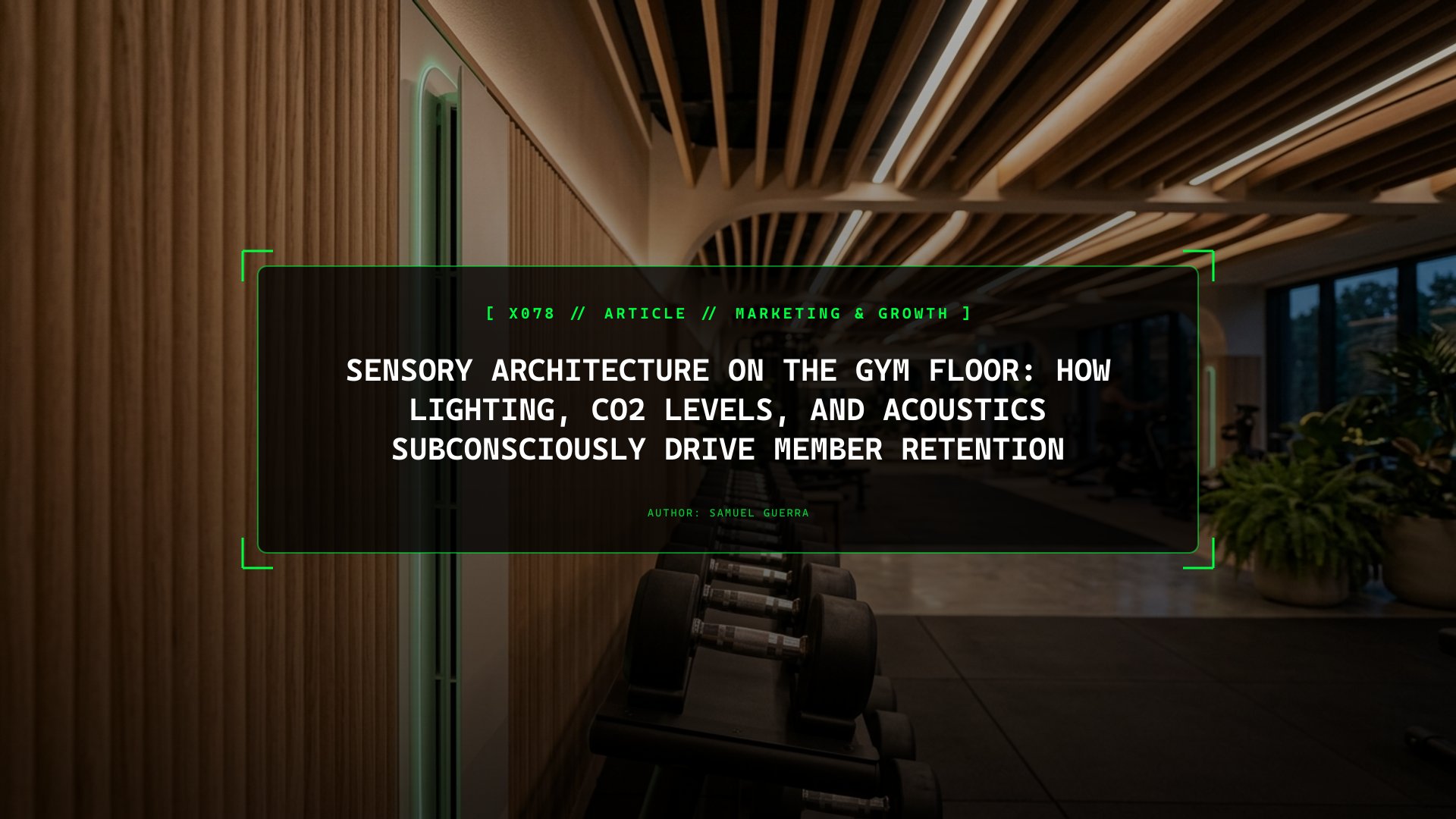
Why Members Blame “Lack of Time” When Their Nervous System Is Actually Fleeing Your Building
When a forty-four-year-old executive or a thirty-five-year-old professional cancels their gym membership after four months, the exit survey almost always records the same polite excuse: “I just don’t have enough time right now.”
Most club owners take that answer at face value. After more than ten years of directing sports facilities, studying exercise physiology, and obsessing over every square meter of Koolfitness and our boutique studio in Nazaré, I can tell you that “lack of time” is rarely the truth. Human beings always find forty-five minutes twice a week for environments that make them feel clear-headed, energized, and neurobiologically safe. When a client quietly stops showing up, it is almost always because their subconscious nervous system has associated your training floor with sensory threat and unexplained fatigue.
Walk into a typical commercial gym at 18:45 on a rainy Tuesday in November with the eyes—and instruments—of an environmental engineer. You will encounter a sensory assault: carbon dioxide ($\text{CO}_2$) concentrations above 2,400 parts per million, stagnant humidity smelling of off-gassing vulcanized rubber and human sweat, blinding 6500-Kelvin overhead LED tubes glaring directly into the retinas of anyone lying on a flat bench, and a 92-decibel acoustic soup of clanging cast iron and distorted speakers bouncing off bare concrete walls.
You can buy €250,000 worth of biomechanically impeccable strength equipment, but if your Sensory Architecture triggers a low-grade fight-or-flight migraine every time a member walks through the turnstile, your retention will bleed. Here is the hard science of how air, light, and sound govern the profitability of a modern fitness facility.
1. Respiratory Engineering: The Hidden Epidemic of Gym-Floor Hypercapnia
At rest behind an office desk, an adult inhales and exhales roughly 6 to 8 liters of air per minute. The moment that same human performs a heavy set of pendulum squats, Romanian deadlifts, or threshold ergometer intervals, their pulmonary minute ventilation ($\dot{V}_E$) surges to 80 to 140 liters per minute. Their metabolic carbon dioxide output multiplies by a factor of ten, alongside aerosolized moisture and volatile organic compounds (VOCs).
Yet an astonishing number of gyms occupy repurposed retail basements or industrial warehouses engineered for passive sedentary occupancy—relying on split-unit air conditioners that merely recirculate and cool the exact same stale indoor air without introducing fresh outdoor oxygen.
According to indoor air quality standards established by the American Society of Heating, Refrigerating and Air-Conditioning Engineers (ASHRAE) and environmental health guidelines from the World Health Organization, indoor air quality degrades rapidly once $\text{CO}_2$ exceeds 1,000 ppm. When we audited conventional fitness rooms during peak evening hours using calibrated non-dispersive infrared (NDIR) sensors, we routinely measured $\text{CO}_2$ levels between 2,100 ppm and 3,200 ppm.
Look at what happens to human physiology when a member trains inside a 2,500 ppm $\text{CO}_2$ chamber:
- Elevated Rate of Perceived Exertion (RPE): Mild hypercapnia slightly lowers blood pH and stimulates central chemoreceptors in the brainstem. A load that should feel like a controlled 7/10 effort suddenly feels like a suffocating 9.5/10 struggle.
- Prefrontal Cognitive Fog & Motor Sloppiness: Research archived by the National Institutes of Health demonstrates that cognitive decision-making and fine neuromuscular coordination drop significantly at 1,500 to 2,500 ppm of $\text{CO}_2$. Members lose mind-muscle connection and experience unexplained dizziness between sets.
- Subconscious Aversion Conditioning: The member leaves the gym with a dull frontal headache and heavy eyelids. They assume “I am just too old or too tired for strength training,” when in reality they were simply oxygen-starved for sixty minutes.
In a high-retention facility, fresh-air exchange is treated as primary performance equipment. By deploying high-capacity Energy Recovery Ventilation (ERV) systems that exchange indoor and outdoor air volumes continuously while maintaining a crisp $18.5^\circ\text{C}$–$19.5^\circ\text{C}$ ambient temperature and 48% relative humidity, we keep floor $\text{CO}_2$ strictly below 800 ppm even at peak capacity. The result is immediate: members finish heavy sessions feeling mentally sharper than when they arrived.
| Environmental Variable | Typical Commercial Gym (18:30 Peak) | Sensory-Engineered Performance Club | Physiological & Retention Impact |
|---|---|---|---|
| Indoor $\text{CO}_2$ Concentration | 2,100 – 3,200 ppm (recirculated AC) | < 800 ppm (automated ERV fresh-air purge) | Eliminates hypercapnic lethargy; lowers RPE by ~15% |
| Ambient Temp & Humidity | $23^\circ\text{C}$–$25^\circ\text{C}$ / 70%+ RH (clammy sweat box) | $18.5^\circ\text{C}$–$19.5^\circ\text{C}$ / 45%–52% RH | Optimizes thermoregulation and evaporative cooling |
| Lighting Architecture | Direct overhead 6500K fluorescent/LED glare | Indirect 3500K–4000K day; 2700K amber evening | Protects supine vision and preserves nocturnal melatonin |
| Acoustic Reverberation ($RT_{60}$) | 1.8 – 2.6 seconds (88–94 dB noise floor) | < 0.55 seconds (68–72 dB controlled soundstage) | Prevents amygdala stress; enables calm technical cueing |
| Olfactory Profile | Stale sweat, chlorine & cheap vulcanized rubber | Neutralized air via MERV-13 + activated carbon | Signals clinical hygiene and institutional prestige |
2. Photobiology and Circadian Lighting: Banishing the 6500K Hospital Glare
Look up at the ceiling the next time you lie down on a flat dumbbell bench, a leg press, or a mobility mat in a standard gym. Nine times out of ten, you are staring straight into an unshielded row of 6000K–6500K blue-enriched LED panels or fluorescent tubes originally designed for a supermarket aisle or a car-repair garage.
This lighting failure damages your business on two distinct levels: psychological self-consciousness and circadian disruption.
First, flat, high-kelvin overhead floodlighting washes out skin tones, highlights every pore and bead of sweat, and eliminates natural topographical contrast. Nobody—whether a competitive athlete or a fifty-year-old beginner—likes looking in a mirror under interrogation-room lighting. By replacing direct ceiling floods with indirect architectural grazing and angled 35-degree accent spotlights (with a Color Rendering Index $\text{CRI} > 92$), the training floor is bathed in warm, three-dimensional contrast. Crucially, the ceiling directly above supine bench zones remains dark and glare-free, allowing the athlete’s visual system to relax between heavy sets.
Second, and even more critical for member health, is the circadian impact of blue-wavelength light at night. As chronobiology studies from Harvard Health Publishing explain, intrinsically photosensitive retinal ganglion cells (ipRGCs) in the human eye are hyper-sensitive to 460–480 nm blue light. When a member trains between 19:30 and 21:00 under 6500K warehouse lights, their pineal gland halts melatonin secretion for up to three hours, destroying their sleep onset at 23:00.
To solve this, we engineer Dynamic Circadian Zoning across the training day:
- 06:30 – 14:00 (Cortisol & Alertness Phase): Strength zones operate at a crisp, indirect 4000K neutral daylight spectrum to accelerate morning wakefulness and neuromuscular reaction speed.
- 14:00 – 19:00 (Balanced Performance Phase): Lighting transitions to a sculptural 3500K warm-white profile with high contrast on the equipment racks and subdued walkways.
- 19:00 – 21:30 (Melatonin Protection & Down-Regulation Phase): Blue wavelengths are progressively dimmed out, shifting the entire facility—especially mobility, stretching, and recovery zones—into a warm 2700K amber glow that allows late-evening trainees to lift hard and still fall into deep slow-wave sleep ninety minutes after leaving the club.
3. Acoustic Engineering: Taming the 90-Decibel Cortisol Chamber
Sound is the most underestimated variable in fitness architecture. Most gym interiors consist of four acoustically reflective surfaces: concrete sub-floors, glass storefronts, mirrored walls, and exposed metal ceilings. In architectural acoustics, this creates a catastrophic Reverberation Time ($RT_{60}$)—the time it takes for a sound impulse to decay by 60 decibels—often exceeding 2.2 seconds.
When a single member drops a 100 kg deadlift or a weight stack slams down in an untreated room, the low-frequency impact wave (20 Hz–120 Hz) travels through the concrete slab while the mid-frequency metallic clang echoes across the glass for two full seconds. To mask that industrial clatter, inexperienced staff crank the background music volume up to 85+ dB. Now coaches have to shout to be heard from one meter away, members have to raise their voices, and the room spirals into the Lombard Effect—an involuntary acoustic arms race that pushes ambient noise past 92 decibels.
Human neurobiology does not tolerate sustained 90-decibel erratic noise. The auditory cortex has direct synaptic projections to the amygdala and the sympathetic nervous system. For a vast segment of high-value clients—particularly executives recovering from cognitive overload, older adults, and women who dislike aggressive “iron dungeon” environments—that wall of noise is the primary reason they dread walking into the gym.
[Acoustic & Structural Quieting Stack]Layer 1 (Sub-Floor Isolation): 30mm–50mm high-density elastomeric vulcanized acoustic tiles under all lifting platformsLayer 2 (Equipment Damping): Urethane-encased plates & dumbbells + hydraulic/elastomeric weight-stack bumpersLayer 3 (Ceiling Absorption): Suspended acoustic baffles & micro-perforated timber panels (NRC ≥ 0.85) cutting RT60 < 0.55sLayer 4 (Directional Soundstage): Distributed low-volume DSP speaker arrays (max 70 dB) with zero-music quiet zones
When you drop a facility’s $RT_{60}$ below 0.55 seconds, something magical happens on the training floor. A coach can give a quiet, precise biomechanical cue at a normal conversational volume (62 dB) from three meters away, and the client hears every syllable clearly. The room feels expensive, composed, and deeply focused.
Automating Sensory Telemetry and Showcasing Your Environment
A club director cannot stand in the middle of the floor holding a decibel meter and a $\text{CO}_2$ analyzer twelve hours a day. Maintaining sensory perfection requires integrating environmental telemetry directly into your business digitalization infrastructure.
In a modern facility, wall-mounted IoT environmental nodes continuously sample $\text{CO}_2$, volatile organic compounds (TVOCs), PM2.5 particulates, ambient temperature, relative humidity, and acoustic pressure. By connecting these streams through custom AI integrations into our building management system, the club anticipates human load before the air ever turns heavy:
- Predictive Pre-Purging: If the booking system shows 42 members reserved for the 18:00 window, the ERV fresh-air dampers ramp to 85% capacity at 17:40, pre-cooling the thermal mass of the room to $18.0^\circ\text{C}$ so that metabolic body heat at 18:30 never pushes the room past $19.5^\circ\text{C}$.
- Automated Acoustic Guardrails: Digital signal processors (DSP) on the audio system dynamically cap ambient output so background music can never exceed 72 dB, regardless of who is at the reception desk.
Finally, do not keep this engineering invisible. High-value clients actively seek out serene, health-first training environments. Elevate your digital presence with architectural photography and transparent data that explain why your club feels completely different from a suffocating budget chain. Pair that architectural storytelling with targeted local SEO so that when discerning residents in your region search for premium private gyms, boutique strength studios, or longevity clubs, your sensory sanctuary is the first place they discover.
Never forget that before a member consciously evaluates your periodization spreadsheet, their lungs, retinas, and inner ear have already rendered a verdict on your club. Engineer the air they breathe, the light they see, and the silence between their sets—and they will never want to train anywhere else.
In practice, we apply these exact architectural standards across specialized sectors including national fitness & gym chains and architecture firms. Whether you are modernizing core workflows through business digitalisation and ai automation for real business workflows, connecting sector-specific requirements to disciplined execution is what turns technical theory into compounding commercial advantage.
[+] [ INDEX_DIRECTORY ] 14 topics ▼
- Why Members Blame “Lack of Time” When Their Nervous System Is Actually Fleeing Your Building
- 1. Respiratory Engineering: The Hidden Epidemic of Gym-Floor Hypercapnia
- 2. Photobiology and Circadian Lighting: Banishing the 6500K Hospital Glare
- 3. Acoustic Engineering: Taming the 90-Decibel Cortisol Chamber
- Automating Sensory Telemetry and Showcasing Your Environment
- Author
- Frequently Asked Questions
- How do elevated indoor carbon dioxide (CO2) levels on a gym floor affect exercise performance?
- What is the optimal CO2 and humidity target for a high-performance training facility?
- Why does overhead 6500K fluorescent lighting hurt member retention?
- How does acoustic reverberation time (RT60) impact executive and female member demographics?
- Can IoT sensors automate sensory architecture in a modern fitness club?
- Related Nodes
- Path Sequence
Frequently Asked Questions
How do elevated indoor carbon dioxide (CO2) levels on a gym floor affect exercise performance?
During vigorous exercise, human minute ventilation increases from 8 liters per minute at rest to over 100 liters per minute. In poorly ventilated commercial gyms at 18:30, indoor CO2 levels routinely spike above 2,000 ppm. This mild hypercapnic environment impairs prefrontal motor focus, elevates perceived exertion (RPE) by 15% to 20%, and leaves members with post-workout lethargy.
What is the optimal CO2 and humidity target for a high-performance training facility?
Elite facilities engineer their HVAC and Energy Recovery Ventilation (ERV) systems to maintain indoor CO2 strictly below 800 to 900 ppm even during peak occupancy, alongside an ambient temperature of 18.5°C to 20°C and relative humidity between 45% and 55%.
Why does overhead 6500K fluorescent lighting hurt member retention?
Harsh 6500K overhead tube lighting casts unflattering downward shadows, induces visual glare during supine exercises like bench pressing, and suppresses evening melatonin production by over 50%—sabotaging the member's sleep architecture when they train after 18:30.
How does acoustic reverberation time (RT60) impact executive and female member demographics?
Bare concrete floors and glass walls create a reverberation time exceeding 2.0 seconds, turning dropped dumbbells and background music into a 90-decibel industrial echo chamber. This triggers acute sympathetic stress in the amygdala. Reducing RT60 below 0.6 seconds via acoustic ceiling baffles and elastomeric sub-flooring creates a calm, focused sanctuary.
Can IoT sensors automate sensory architecture in a modern fitness club?
Yes. By connecting non-dispersive infrared (NDIR) CO2 sensors, decibel meters, and circadian DMX lighting controllers into the club's digital operations hub, ventilation dampers open automatically before peak hours and lighting color temperatures shift seamlessly from energizing 4000K daylight at 08:00 to restorative 2700K warm amber after 19:30.
[ RELATED_NODES ]
> START_PROJECT
Need a website that earns trust, ranks in search, and gives your business a stronger digital presence? Start the conversation here.