 X078
16:9 vs 2.39:1 Anamorphic Widescreen in Wedding Cinema Explained
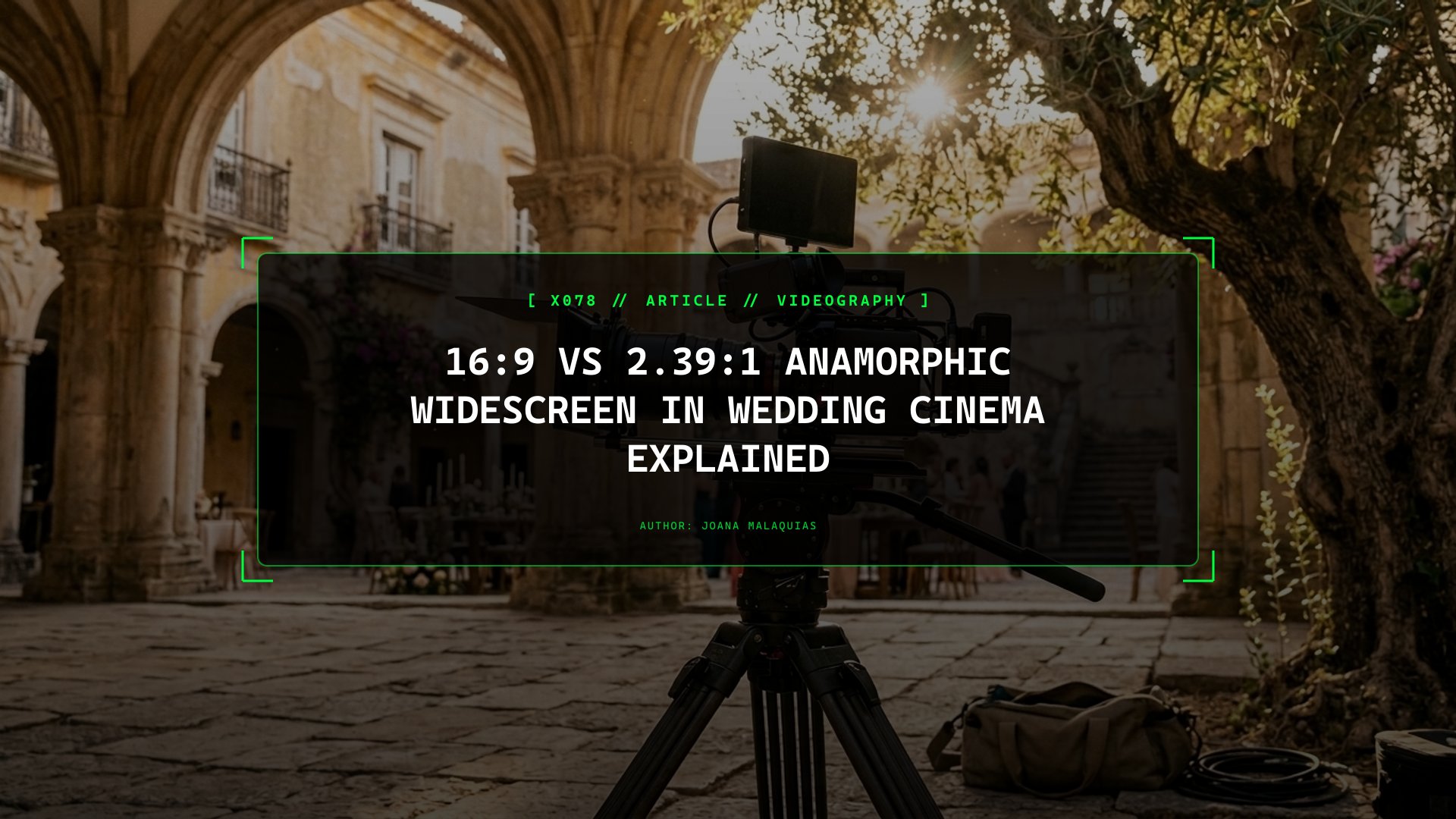
The Geometry of Emotion: Beyond the Standard TV Box
Every time you watch a movie in a theater or pull up your favorite prestige drama, your brain responds instantly to the physical shape of the frame.
Most consumer video—from television broadcasts to home video recordings—is captured in the standard 16:9 (1.78:1) aspect ratio. It is practical, functional, and built to fill computer monitors and living room televisions without black bars.
Yet when couples watch wedding films produced at Joana Malaquias, they often comment that our work “feels like a real movie.” They cannot immediately identify why, but their senses know something profound has shifted.
A significant part of that cinematic weight lies in the intentional adoption of the 2.39:1 widescreen anamorphic aspect ratio.
Aspect ratio is not a decorative filter or black bars arbitrarily pasted over a timeline in post-production. It is the geometric language through which we understand the relationship between a couple and their surroundings.
Through our dedicated video production workflows, we use the widescreen format to weave personal intimacy directly into the grand architectural and natural tapestry of Portugal.
ASPECT RATIO COMPARISON & FIELD OF VIEW
- STANDARD 16:9 (1.78:1) RECTANGLE:
- Couple Portrait: Tall, vertical room
- Lots of empty ceiling
- CINEMATIC ANAMORPHIC 2.39:1 EXPANSIVE SCOPE:
- Portuguese Landscape: [Intimate Couple] [Atmosphere]
- Expansive horizontal sweep; human connection anchored in world
Anamorphic Optics: The Science of the Squeeze
To appreciate true cinematic widescreen, one must distinguish between “cropping” and “true anamorphic capture.”
Many videographers achieve widescreen by simply slapping black letterbox bars over a standard spherical 16:9 image. While this changes the frame shape, it throws away millions of pixels from the top and bottom of the sensor, reducing vertical resolution and light gathering.
True anamorphic filmmaking operates on an entirely different optical principle:
ANAMORPHIC OPTICAL SQUEEZE & DE-SQUEEZE DYNAMICS
- Wide Real-World Horizon: (Captures 1.5x wider lateral view)
- CYLINDRICAL ANAMORPHIC GLASS ELEMENTS
- Optically compresses horizontal light onto camera sensor
- Camera Sensor: Sony Full Frame: (Records tall, squeezed pixels)
- DaVinci Resolve Fairlight/Color Timeline: 1.5x / 1.8x De-Squeeze
- Yields 2.39:1 aspect ratio with full sensor resolution + oval bokeh
Anamorphic lenses contain cylindrical glass elements that squeeze the image horizontally onto the sensor during recording. When de-squeezed in post-production using suites like Blackmagic Design DaVinci Resolve, you gain three unique optical characteristics:
- Oval Bokeh: Instead of circular out-of-focus highlights, background candlelight and fairy bulbs render as vertical ellipses, creating a dreamy, painterly depth.
- Horizontal Flares: When low-angle sun strikes the glass, flares streak gracefully across the frame rather than washing out the entire image in a haze.
- Dimensional Perspective: You obtain the wide horizontal perspective of a 35mm lens combined with the shallow depth of field and intimate subject separation of a 50mm lens.
Environmental Context: Portugal’s Panoramic Landscapes
Why is 2.39:1 particularly suited for weddings in Portugal? Because the Portuguese landscape is fundamentally panoramic.
Consider standing on the belvedere overlooking the Douro River, the rolling crests of the Serra da Arrábida, or the tiled facades of an 18th-century palace in Sintra. These environments are horizontal tapestries.
In a standard 16:9 frame, if you frame the couple’s heads and shoulders, the horizontal edges are abruptly sliced away. You see the bride and groom, but you lose the context of the centuries-old vineyard terracing that drops toward the water.
In a 2.39:1 frame, the couple can occupy the center third of the composition with deep, three-dimensional clarity, while the remaining two-thirds of the screen celebrate the sweeping horizon, the ancient stone balustrades, and the golden clouds drifting across the Atlantic.
This balance between character intimacy and monumental geography transforms your wedding into an enduring piece of visual art that enriches your personal digital presence.
The Psychological Intimacy of Negative Space
Widescreen composition does something magical to human psychology.
In traditional photography, beginners are often taught to center the subject and eliminate “dead space.” In cinematic storytelling, however, negative space is where emotion lives.
When a bride is seated on a vintage chaise lounge reading a handwritten letter from her partner, framing her in 2.39:1 allows her figure to sit on the far right third of the frame. The left two-thirds of the screen remain quiet—filled only with the gentle morning shadow falling across antique wooden floors.
That empty space does not feel barren; it feels pregnant with anticipation. It echoes the quiet solitude of the moment before her life changes forever. It invites the audience to lean in, to listen, and to feel the weight of her thoughts.
Using professional cine sensors from Sony, we maintain rich detail across these broad shadows, ensuring that neither the highlights of the dress nor the deepest corners of the room are lost to digital noise.
Mobile Adaptation and Future-Proof Archives
A common question modern couples ask is: “Will our widescreen film still look spectacular on iPhones, tablets, and social media?”
The answer is an emphatic yes. In fact, modern high-end smartphones are engineered with ultra-wide OLED screens that naturally match cinematic ratios when held horizontally.
Furthermore, our technical pipeline developed with Webxtek exports master files in full DCI 4K resolution. Whether projected onto a home theater screen in thirty years or viewed on a handheld device today, the 2.39:1 anamorphic experience delivers an unmistakable mark of timeless prestige.
In practice, we apply these exact architectural standards across specialized sectors including wedding photographers and corporate event photographers. Whether you are modernizing core workflows through video production for digital impact and digital design that stops the scroll, connecting sector-specific requirements to disciplined execution is what turns technical theory into compounding commercial advantage.
[+] [ INDEX_DIRECTORY ] 13 topics ▼
- The Geometry of Emotion: Beyond the Standard TV Box
- Anamorphic Optics: The Science of the Squeeze
- Environmental Context: Portugal’s Panoramic Landscapes
- The Psychological Intimacy of Negative Space
- Mobile Adaptation and Future-Proof Archives
- Author
- Frequently Asked Questions
- What is the difference between standard 16:9 video and 2.39:1 widescreen?
- What is an anamorphic lens and why does it look different from standard lenses?
- Can 2.39:1 widescreen films still look good on modern smartphones?
- Does shooting anamorphic make close-up emotional portraits harder?
- Related Nodes
- Path Sequence
Frequently Asked Questions
What is the difference between standard 16:9 video and 2.39:1 widescreen?
Standard 16:9 fills ordinary television screens and smartphones vertically. The 2.39:1 aspect ratio (often called CinemaScope) is significantly wider, offering an expansive horizontal canvas used by Hollywood feature films to convey epic environmental scale.
What is an anamorphic lens and why does it look different from standard lenses?
Anamorphic lenses use cylindrical optical elements that optically squeeze a wide field of view onto a normal camera sensor. When de-squeezed in post-production, they yield distinctive oval-shaped bokeh, gentle edge falloff, and subtle horizontal streaks.
Can 2.39:1 widescreen films still look good on modern smartphones?
Yes. When turned horizontally, modern mobile displays with ultrawide aspect ratios display 2.39:1 content natively without letterboxing. Even in vertical orientations, cropped social cutdowns can be framed intentionally during shooting.
Does shooting anamorphic make close-up emotional portraits harder?
Anamorphic lenses traditionally have longer minimum focus distances, but modern cinema diopters and modern optical engineering allow intimate, tack-sharp close-ups while retaining the dreamy, dimensional background separation.
[ RELATED_NODES ]
> START_PROJECT
Need a website that earns trust, ranks in search, and gives your business a stronger digital presence? Start the conversation here.