 X078
Super 8 Film Meets 4K Digital Cinema: Why Couples Are Demanding Hybrid Analog Nostalgia in 2026
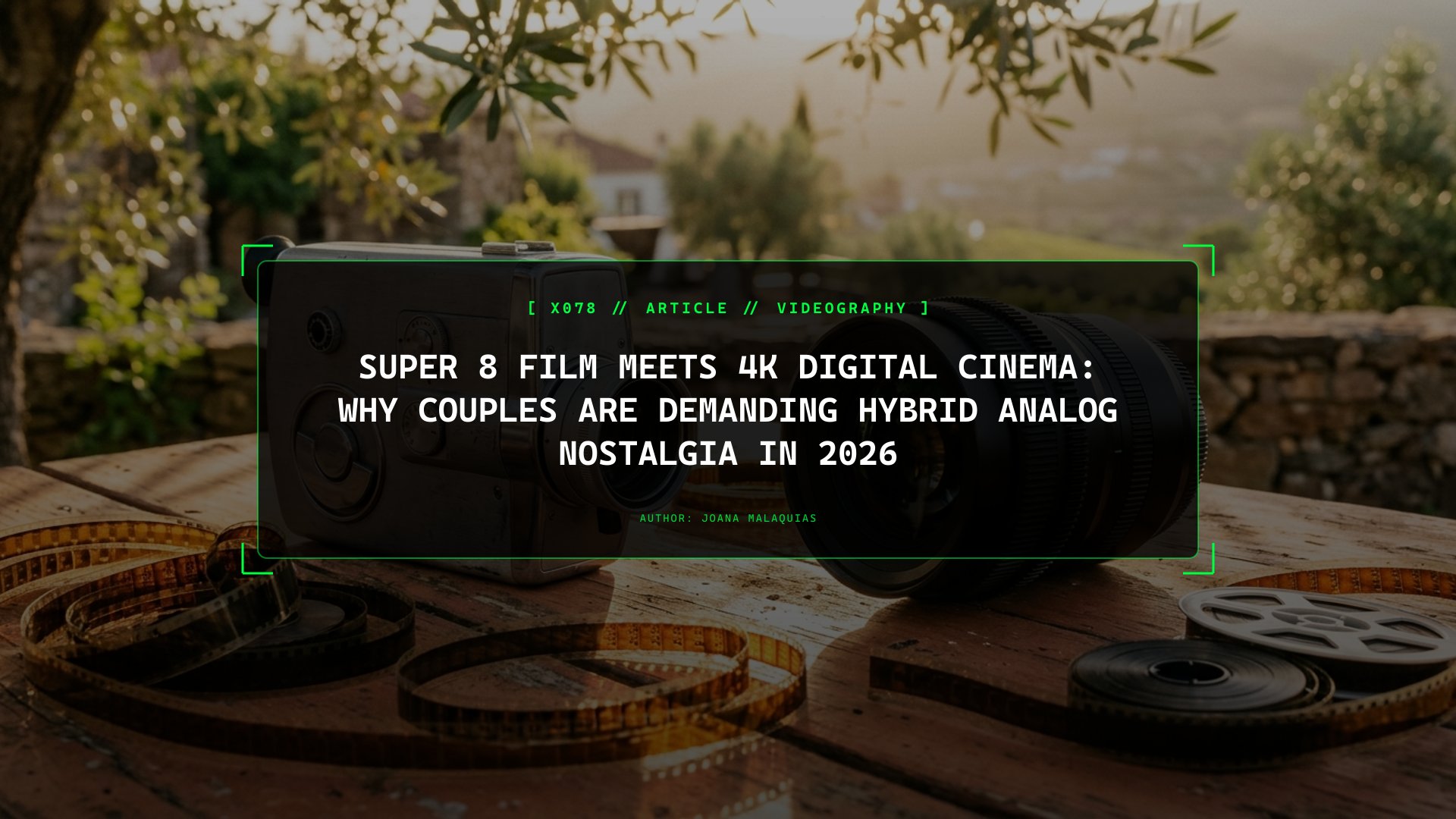
The Clockwork Whirr That Disarms a Room
There is a specific sound that changes the emotional temperature of a room at a wedding faster than any piece of direction I could ever speak aloud. It is the soft, rhythmic mechanical whirr—eighteen frames per second—of a 1974 Canon 814 XL Electronic Super 8 camera advancing real celluloid film past a brass gate.
Last June, during bridal preparations in a quiet bedroom overlooking the Atlantic in Ericeira, the bride’s father walked in wearing his tailored suit for the first time. He is a reserved Portuguese engineer who had confessed to me at our rehearsal coffee that he hated having his picture taken. Had I pointed a rigged-out digital cinema camera with a matte box and external monitor at his face, he would have frozen into a polite statue.
Instead, I kept my 4K digital camera resting discreetly on a low tripod in the corner, quietly recording the wide composition and the 32-bit float room audio, while I raised my compact vintage Super 8 camera to my eye.
When he heard that tiny clockwork purr of the analog motor, his shoulders dropped two inches. A childhood memory flickered across his face—the memory of his own father filming summer holidays in the 1970s. He smiled, walked straight over to his daughter without looking at the lens, adjusted the collar of her robe, and kissed her forehead. Those eleven seconds of Kodak Vision3 50D celluloid—when it came back from the chemical lab three weeks later with its warm amber halation and trembling organic grain—looked less like a commercial video clip and more like a dream someone had managed to pull directly out of the human heart.
Across Portugal and Europe in 2026, I am seeing an extraordinary surge in couples asking for hybrid analog-digital wedding cinema. Through my work at Joana Malaquias and our archival documentary projects at Subtil Memória, hybrid filmmaking has become one of the most requested artistic signatures we offer. And it is not happening because couples want a hipster retro gimmick. It is happening because, in an era where digital screens are hyper-clinical and artificial intelligence can synthesize pixel-perfect video out of thin air, physical light burning real silver halide crystals onto a strip of plastic is the ultimate proof that a moment actually happened.
Why Fake Digital “Film Overlays” Always Feel Hollow
Walk through social media in 2026 and you will see thousands of wedding clips plastered with fake Super 8 borders, looped dust scratches, and artificial jitter effects downloaded from template marketplaces. To an untrained eye scrolling on a phone for three seconds, a digital filter might pass as “vintage.” When you sit down in a darkened living room to watch a twenty-minute family film on a large screen, however, fake analog emulation falls apart immediately.
Why? Because digital sensors and photochemical emulsion record reality through fundamentally different laws of physics.
A CMOS digital cinema sensor is a uniform microscopic grid of millions of identical silicon photosites sitting in the exact same place on every single frame. Even when you add digital grain in post-production, the underlying geometry of the image remains mathematically rigid, and clipped digital highlights turn into flat, lifeless white squares.
When light passes through the vintage glass lens of a Super 8 camera onto real Kodak celluloid film, there are no pixels. Every single frame contains a completely new, randomly distributed cloud of microscopic silver halide crystals of varying sizes and sensitivities. Bright sunlight reflecting off a bride’s silk veil or a champagne glass penetrates the emulsion layers and scatters off the film base, creating a warm, glowing red-orange aura around the highlights known as halation. Furthermore, because the film is pulled physically through the camera gate by a tiny mechanical claw at 18 frames per second rather than the digital standard of 24, 25, or 60 frames per second, motion acquires a slightly impressionistic, poetic cadence that mirrors how human memory actually recalls the past.
| Dimension of Medium | 4K / 6K Digital Cinema Camera | Real Super 8mm Celluloid Film | Why Hybrid Combines Both |
|---|---|---|---|
| Temporal Cadence | 24 fps / 25 fps / 50 fps smooth, lifelike temporal fidelity. | 18 fps mechanical transport; dreamy, memory-like motion blur and subtle gate weave. | Digital anchors the literal “present tense” of vows; Super 8 evokes the timeless “past tense” of nostalgia. |
| Highlight & Color Physics | Clean linear sensor capture; exceptional shadow detail at high ISO under candlelit dinners. | Photochemical silver halide emulsion; lush highlight roll-off, natural halation, and rich organic skin warmth. | Super 8 thrives in bright Portuguese sun and twilight; 4K digital rescues dark stone chapels and midnight dancefloors. |
| Shooting Discipline | Continuous recording (60+ minutes per CFexpress card); zero fear of missing a long speech. | 3 minutes and 20 seconds per 50-foot cartridge at 18 fps; every trigger pull is a deliberate curation. | Digital provides complete documentary safety; Super 8 forces the filmmaker to hunt for pure poetic fragments. |
| Acoustic Capability | Synced with dual-system 32-bit float field recorders for crystal-clear vows and speeches. | Silent cartridges (mos); records no synchronous digital audio track on the film strip itself. | Digital carries the full acoustic spine of the film while Super 8 visual passages float over the real audio bed. |
The Scarcity Principle: What 200 Seconds of Film Teaches a Documentary Eye
There is a hidden creative benefit to bringing a Super 8 camera to a wedding that even many filmmakers underestimate: scarcity sharpens observation.
When you shoot exclusively on digital media, storage is essentially infinite. A pair of 512GB CFexpress cards can hold hours of raw 4K footage. That abundance is essential during the ceremony and the speeches—where I never stop rolling—but during the rest of the day, infinite storage can tempt a tired videographer into “spraying and praying,” holding the shutter down lazily and hoping to find a story in the editing room later.
A single 50-foot cartridge of Super 8 film running at 18 frames per second gives you exactly 200 seconds of life.
When you know you only have three cartridges—ten minutes of total celluloid—for an entire wedding day in Sintra or the Douro Valley, your way of seeing transforms completely. You stop filming transitions for the sake of transitions. You wait. You watch the light hit the dust motes inside the sacristy. You watch the bride’s grandmother adjusting her shawl in the back of the vintage car. You press the mechanical trigger for four seconds—whirrrrrr-click—capturing the exact micro-moment of a laugh, a wind-swept embrace on the cliffs, or the confetti falling through the courtyard trees, and then you release the trigger.
Every single frame on that cartridge was chosen with intention, paid for in physical film stock and chemical laboratory development, and exposed only once. You cannot look at an LCD screen on the back of a 1970s Super 8 camera to check if you got the shot. You have to trust your light meter, your distance focus ring, and your instinct. That vulnerability between the filmmaker, the mechanical tool, and the couple creates an electric creative honesty that radiates from the screen.
Selecting the Right Emulsion for Portuguese Light
Portugal possesses some of the most dramatic, high-contrast natural light in Europe. Shooting analog film in the misty woodland microclimate of Sintra requires a completely different photochemical strategy than shooting on a sun-bleached limestone terrace in the Algarve or the white sand dunes of Comporta.
In my hybrid documentary workflow, I pack three specific Kodak negative and reversal stocks depending on the hour and architecture of the celebration:
- Kodak Vision3 50D (Color Negative, 50 ISO Daylight): My absolute workhorse for outdoor ceremonies, vineyard cocktails, and coastal afternoons in Portugal. Because its sensitivity is a slow 50 ISO with ultra-fine T-Grain emulsion, it handles the blazing Iberian midday and golden-hour sun with effortless grace. It refuses to blow out white wedding dresses even under direct sunlight, rendering skin tones with a creamy, pastel warmth and turning Atlantic blues into deep, painterly cyan.
- Kodak Vision3 200T (Color Negative, 200 ISO Tungsten): Balanced for 3200K tungsten light, I use 200T (with an 85A warming filter outdoors during blue hour, or unfiltered indoors) during late bridal preparations in historic stone quintas and early twilight dinners under warm string lights. It bridges the transition between day and night with a slightly richer, more tactile grain structure.
- Kodak Vision3 500T & Tri-X Reversal (High-Speed Night & Classic Monochrome): When the dancefloor erupts at midnight under outdoor lanterns or sparklers, or when a couple marries inside a dimly lit baroque chapel in Lisbon, 500T embraces the shadow grain unapologetically. And for couples who love timeless editorial contrast, loading a single cartridge of Tri-X black-and-white reversal film for the late-night party creates an iconic, raw documentary energy.
Weaving Two Mediums Into One Seamless Narrative in Post-Production
The biggest mistake inexperienced editors make when cutting a hybrid wedding film is treating the Super 8 footage like a separate music video tacked onto the beginning or end of the digital film. If the viewer feels jolted every time the timeline cuts between 4K digital cinema and Super 8mm scan, the illusion breaks.
In my editing suite, using Blackmagic Design DaVinci Resolve Studio, the two formats are woven together like two instruments in a chamber duet—where each medium plays a specific psychological role in the storytelling.
First, we never ask the film laboratory for a baked-in Rec.709 video file with crushed blacks and cropped edges. We commission a 2K or 4K flat log overscan of the full negative, including the physical sprocket hole and the raw camera gate edge on the left side of the frame. Receiving a high-bit-depth ProRes 4444 log scan gives us the latitude to color-grade the Super 8 celluloid alongside our 10-bit/12-bit 4K digital cinema log footage inside a unified DaVinci Wide Gamut color space.
Second, we use the acoustic bridge to unify the visual contrast. Suppose the groom is reading a deeply personal vow during the ceremony, captured in crystal-clear 4K digital cinema with 32-bit float lapel audio. As his voice speaks about the first summer they traveled together along the Alentejo coast, we hold his real ceremony voice in the audio track while cutting visually for six seconds to a silent, sun-drenched Super 8 shot of the two of them laughing barefoot in the vineyard an hour earlier, with the natural sound of the camera’s mechanical shutter softly layered underneath.
When couples watch these hybrid films on Vimeo or on their private archival drives, they experience the best of both worlds: the intellectual and acoustic clarity of modern cinema paired with the visceral, tactile texture of how a memory actually feels inside the mind.
How Hybrid Visual Craft Elevates Creative Studios, Venues, and Luxury Brands
This hunger for tactile, non-synthetic visual texture is not confined to wedding couples. Across the luxury hospitality, slow fashion, artisanal gastronomy, and destination event sectors in Portugal, creative directors have realized that sterile, hyper-digital promotional videos all look identical in 2026.
When we produce commercial brand stories and bespoke video production for boutique hotels, bridal couturiers, and historic quintas, integrating real Super 8mm celluloid alongside 4K digital cinema immediately separates the brand from every competitor using generic stock templates. A thirty-second hybrid film showing linen tablecloths blowing in the breeze, artisanal ceramics being plated, and guests arriving at a coastal estate on real Kodak film signals heritage, craftsmanship, and emotional permanence.
Of course, shooting real celluloid and high-bitrate 4K cinema is wasted if the digital platform displaying the work crushes the grain into muddy compression artifacts. That is why visual storytelling must be paired with intentional editorial branding and hosted on high-performance websites engineered for high-bitrate adaptive streaming. When you combine unmistakable analog-digital visual identity with targeted local SEO, a boutique venue or creative studio in Portugal stops competing on price and becomes a category of one for discerning international clients.
The Cartridge in the Wooden Box
Every time I deliver a hybrid wedding collection, I love thinking about the dual nature of what the couple is receiving. They receive their digital cinema masters, of course—redundant, high-bitrate files ready to play on any screen for decades to come.
But there is also something deeply moving about knowing that those three minutes of Super 8 moments exist physically in the material world: real strips of developed celluloid where the actual photons of their wedding day in Portugal touched silver crystals and left a permanent physical trace. In a century that is becoming more virtual, ephemeral, and synthetic every year, holding onto something real is the greatest luxury we have left.
In practice, we apply these exact architectural standards across specialized sectors including bridal & wedding shops and wedding & event djs. Whether you are modernizing core workflows through video production for digital impact and high-performance websites, connecting sector-specific requirements to disciplined execution is what turns technical theory into compounding commercial advantage.
[+] [ INDEX_DIRECTORY ] 16 topics ▼
- The Clockwork Whirr That Disarms a Room
- Why Fake Digital “Film Overlays” Always Feel Hollow
- The Scarcity Principle: What 200 Seconds of Film Teaches a Documentary Eye
- Selecting the Right Emulsion for Portuguese Light
- Weaving Two Mediums Into One Seamless Narrative in Post-Production
- How Hybrid Visual Craft Elevates Creative Studios, Venues, and Luxury Brands
- The Cartridge in the Wooden Box
- Author
- Frequently Asked Questions
- What is a hybrid Super 8 and 4K digital wedding film?
- Why not just apply a digital Super 8 filter or LUT to 4K footage in post-production?
- How many minutes of footage does a single Super 8 film cartridge hold?
- How does the presence of a vintage Super 8 camera change how wedding guests behave?
- How long does it take to develop and scan Super 8 film for a hybrid wedding edit?
- Related Nodes
- Path Sequence
Frequently Asked Questions
What is a hybrid Super 8 and 4K digital wedding film?
A hybrid wedding film weaves together two distinct mediums in a single narrative edit: real analog Super 8mm celluloid film cartridges shot on vintage mechanical cameras and high-dynamic-range 4K digital cinema footage paired with 32-bit float field audio. The digital camera anchors the spoken vows, speeches, and low-light intimacy, while the Super 8 captures tactile, dreamlike emotional memory.
Why not just apply a digital Super 8 filter or LUT to 4K footage in post-production?
A digital overlay repeats a mathematical grain texture and places a static border over clean digital pixels. Real Kodak Super 8 celluloid is a physical, photochemical process where silver halide crystals react unpredictably to photons at 18 frames per second, producing organic halation around highlights, gate weave, and color depth that no plugin can counterfeit.
How many minutes of footage does a single Super 8 film cartridge hold?
A standard 50-foot Super 8 cartridge running at 18 frames per second yields approximately 3 minutes and 20 seconds of raw footage (or 2 minutes and 30 seconds at 24 fps). Because every second of film stock and laboratory chemical development carries a real cost, the filmmaker shoots with extreme intentionality.
How does the presence of a vintage Super 8 camera change how wedding guests behave?
When guests see a modern digital cinema rig, they often become self-conscious. When I raise a small 1970s mechanical Super 8 camera to my eye and they hear the gentle clockwork whirr of the motor, their faces immediately soften into playful curiosity and unguarded nostalgia, as if they were in a family home movie from childhood.
How long does it take to develop and scan Super 8 film for a hybrid wedding edit?
After the wedding, the exposed cartridges are shipped to a specialized motion picture film laboratory for ECN-2 chemical processing, followed by a frame-by-frame 2K or 4K overscan in log profile. This laboratory workflow typically takes two to three weeks before the analog scans are color-matched alongside the 4K digital masters.
[ RELATED_NODES ]
> START_PROJECT
Need a website that earns trust, ranks in search, and gives your business a stronger digital presence? Start the conversation here.