 X078
The Future of Memory: Why Authentic Wedding Cinema Beats AI Perfection in the 2026–2030 Era
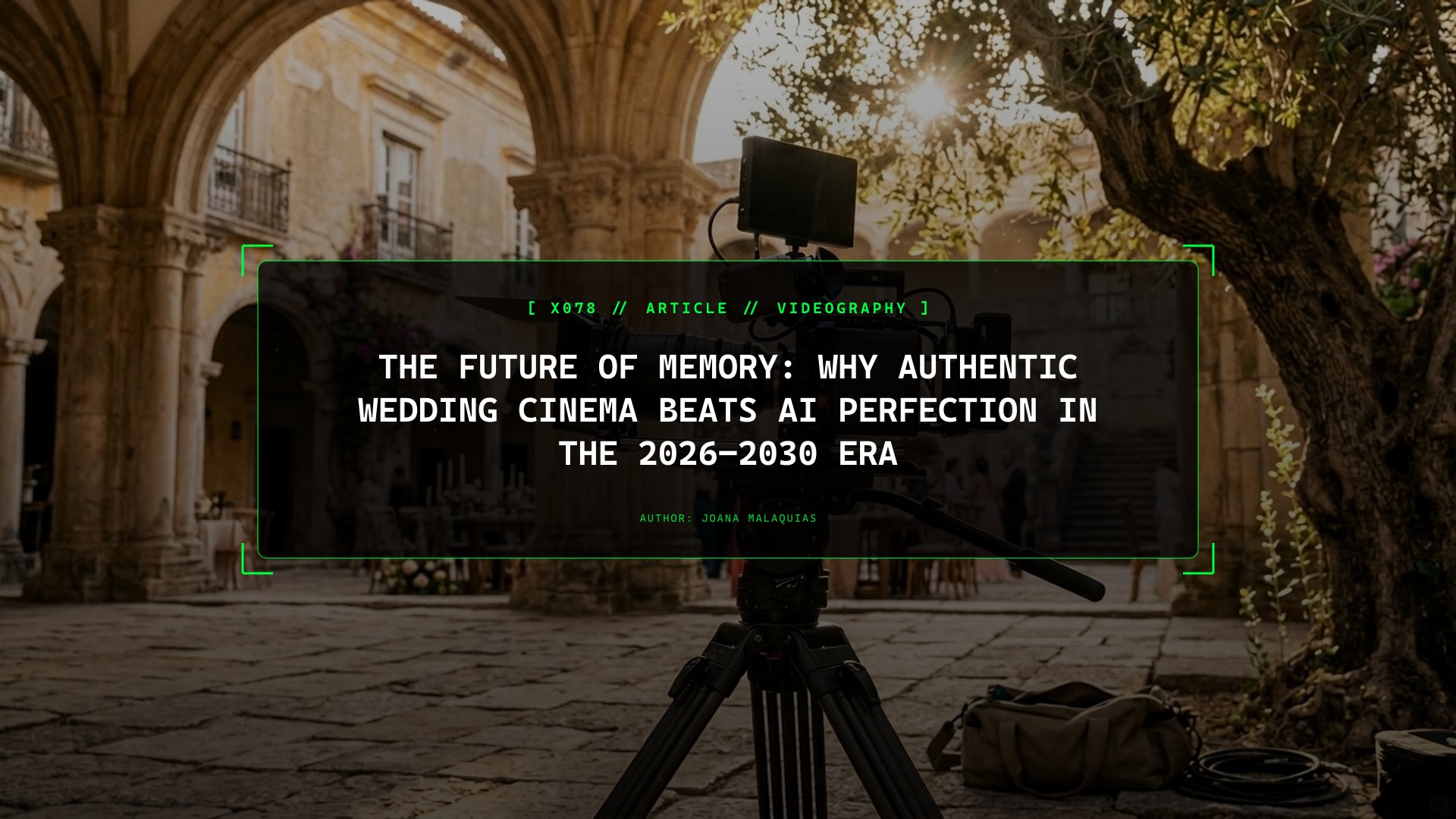
The Uncanny Valley of Synthetic Perfection
Last September, at a seventeenth-century estate nestled in the hills between Sintra and Mafra, I watched the father of the bride pause mid-sentence during his dinner toast. He had folded a small piece of squared notebook paper four times in his jacket pocket. When he unfolded it under the warm glow of candlelight, his right hand was shaking so visibly that the paper rustled against the capsule of my discreet lapel microphone. For six full seconds, he said nothing. He looked across the long wooden table at his daughter, took a slow breath through his nose, laughed at his own emotion, and wiped his glasses with the corner of a linen napkin before speaking a single word.
When I sat in my editing room two weeks later, that six-second silence became the structural spine of the entire twenty-minute film. If you ran that clip through any of the automated AI video editing suites currently flooding the market in 2026, the algorithm would classify those six seconds as dead air. An automated trimmer would cut the pause to keep the pacing snappy; an AI audio cleaner would strip out the delicate rustle of the paper and the sharp intake of breath; a generative stabilization and retouching filter would smooth the tremor out of his fingers and erase the moisture gathering in the lower creases of his eyes.
In doing so, the software would destroy the very reason we film weddings in the first place.
We have entered a four-year window—between 2026 and 2030—where synthetic visual perfection has become completely free, instantaneous, and utterly worthless. Any smartphone or cloud render farm can generate a flawless sunset over the Atlantic, synthesize a missing drone transition, or reconstruct a missed camera angle using generative diffusion models. Yet the more our daily digital feeds fill with frictionless, hyper-polished synthetic imagery, the more fiercely couples and families crave the opposite: verifiable human truth. Through my work at Joana Malaquias and our dedication to preserving intimate family histories through Subtil Memória, I have watched a profound cultural correction unfold. The couples coming to Portugal from London, New York, Zurich, and Lisbon are no longer asking for Hollywood music videos where they look like porcelain mannequins. They are asking for living, breathing documentary cinema that honors the unrepeatable friction of reality.
Why Imperfection Is the Only Archive That Ages With Grace
When I began filming small everyday moments back in Torres Vedras as a teenager, I was fascinated by how video changes value over time. A photograph freezes a fraction of a second into a monument; a film preserves the duration of a human presence—the cadence of a laugh, the specific way someone turns their head when their name is called across a crowded courtyard, the weight of a hand resting on a shoulder.
During the first year after a wedding, couples watch their film to relive the euphoria of the party. Ten years later, they watch it to show their children how young and wildly in love they were. Thirty years later, they watch that same film to hear the voices of the people who are no longer sitting at the Christmas table.
| Dimension of Craft | Algorithmic / AI-Polished Video (2026 Standard) | Authentic Documentary Cinema (2026–2030 Craft) |
|---|---|---|
| Pacing & Rhythm | Beat-matched cuts every 1.8 seconds; dead air automatically excised by software. | Breathing room dictated by human emotion; lingering 6-to-12-second holds on silent reactions. |
| Visual Texture | Plastic skin smoothing, synthetic sky swaps, hyper-sharpened digital edges, AI frame interpolation. | Organic optical softness from vintage or cinema prime glass, natural shadow roll-off, authentic 16mm/35mm film emulation in Blackmagic Design DaVinci Resolve. |
| Audio Architecture | Aggressive AI voice isolation that strips room acoustics and replaces ambiance with generic stock music. | Dual-system 32-bit float field recording preserving room tone, wind in the stone pines, laughter, and trembling breaths. |
| Emotional Longevity | Feels dated within 18 months as social media visual trends and generative filters shift. | Gains emotional gravity every decade as an unaltered historical document of real people. |
Look closely at what happens when we over-process human memory. In the late 2010s and early 2020s, the wedding industry went through an era of heavy-handed orange-and-teal LUTs, relentless gimbal orbits, and slow-motion walks staged four times in a row until the dress flowed just right. When couples revisit those films today, many confess a quiet sense of alienation: they remember the exhaustion of performing for the camera rather than the feeling of being married.
Today, the temptation is even more insidious because it happens in post-production without the couple even asking. Software vendors promise videographers that AI can “fix” a squinting eye, “clean” a wind-swept lock of hair across a bride’s cheek, or “re-light” a dimly lit stone chapel. I refuse every single one of those tools. That wind-swept hair is the Atlantic nortada blowing across the cliffs of Ericeira at seven in the evening. That dim, amber candle-glow inside a centuries-old parish church is the exact atmosphere the couple chose when they planned their ceremony. As camera manufacturers like ARRI have proved for over a century of narrative cinema, true visual beauty never comes from clinical sharpness or synthetic reconstruction—it comes from dynamic range, natural highlight roll-off, and the way glass renders skin tones under imperfect, real-world light.
Spatial Video, Immersive Headsets, and the Myth of the 360-Degree Frame
One of the most frequent questions I hear from international couples and creative directors planning ahead toward 2028 and 2030 is whether spatial video and stereoscopic headsets will replace traditional flat-screen wedding films. Now that lightweight stereoscopic cameras and spatial capture rigs can record depth-mapped 8K footage, there is a technological push to turn family memories into virtual environments you step inside.
I have tested spatial capture extensively, and my conclusion as a documentary filmmaker is clear: spatial video is a fascinating archival supplement, but it will never replace the emotional power of a directed 2D cinema frame.
Why? Because cinema is the art of exclusion and focus.
When you wear a headset and look around a spatial recording of a wedding ceremony, you are placed in the position of a distracted bystander. You look left at the catering staff setting down champagne glasses; you look up at the timber beams; you miss the exact millisecond when the groom’s mother reaches over to squeeze his sister’s hand. In a spatial environment, everything is present, which means nothing is emphasized.
When I hold a camera with a fast 50mm or 85mm prime lens, I am making a hundred micro-decisions every minute on behalf of your future self. I am choosing to throw the busy background into a soft wash of out-of-focus light so that your entire soul is drawn to the micro-expression on your partner’s face as you walk down the aisle. I am choosing to stay low, shooting through the gap between two guests’ shoulders, so the camera feels like a quiet confidant rather than an intruder. When we publish curated narrative essays on Vimeo or deliver private cinema masters to our clients, the emotional impact comes from montage—the juxtaposition of a grandfather’s weathered hands resting on a wooden cane cut directly against the newborn niece sleeping in her mother’s arms during the party. Montage is an editorial language written in time and framing, not in three-dimensional geometry.
Where spatial video does earn a modest place between now and 2030 is in raw environmental preservation: a five-minute stationary stereoscopic recording of the dinner table conversation where family members can sit and observe the room decades from now. Even there, the technology only serves the memory if it remains completely invisible on the day itself. The moment a camera rig looks like a piece of laboratory hardware, people stiffen, self-consciousness takes over, and the documentary truth evaporates.
Sound Is Eighty Percent of What Makes You Cry Twenty Years Later
If you mute the greatest wedding film ever shot, you are left with an aesthetic slideshow. If you close your eyes and listen to the soundtrack of a masterfully recorded documentary wedding film, you can see the entire day in your mind.
As visual generation tools become ubiquitous, acoustic authenticity has become the sharpest dividing line between amateur videography and serious documentary craft. You can fake a transition, and an untrained viewer might not notice; you cannot fake the acoustic signature of a stone courtyard in Alenquer at dusk, where the clinking of porcelain espresso cups mingles with distant acoustic guitar and the laughter of eighty people speaking three different languages.
My field audio workflow is built on three non-negotiable pillars that borrow directly from independent documentary cinema:
- Redundant 32-Bit Float Micro-Recorders: We wire the groom, the officiant, and often the bride (hidden delicately inside the structure of the dress or veil using medical-grade acoustic tape and wind-fur mounts) with ultra-compact 32-bit float recorders. Because 32-bit float captures an immense dynamic range above and below 0 dBFS, a sudden burst of laughter or an unexpected shout of joy right next to the microphone capsule never distorts, and a barely audible whispered “I love you” at the altar can be brought up in the mix with zero digital hiss.
- Multi-Track Soundboard + Ambient Miking: During speeches and live music, pulling a single mono feed from the DJ’s mixer gives you a dry, sterile vocal that sounds detached from the room. I always pair direct XLR/TRS feeds with a stereo pair of condenser microphones capturing the room’s natural reverberation and the guests’ real-time reactions. When the best man tells a joke, you need to hear the room erupt around him, not just his voice in a vacuum.
- Diegetic Sound Design (Foley of the Real Day): Throughout the day, my camera microphone is never turned off. I deliberately record fifteen-second wild tracks of the environment: the crunch of gravel under leather shoes, the Atlantic breeze moving through eucalyptus leaves, the pop of a cork, the church bells echoing across the valley. In the edit, these real diegetic sounds are woven underneath the visual cuts in Blackmagic Design DaVinci Resolve Fairlight, creating a tactile sensory tapestry before a single note of licensed music ever enters the timeline.
How Documentary Truth Elevates Luxury Brands, Venues, and Creative Studios
Although weddings are the beating heart of my personal craft, the exact same shift away from synthetic perfection is transforming how discerning businesses communicate online. Over the past two years, I have worked alongside boutique wedding estates, floral ateliers, bridal designers, and regional hospitality founders who realized that polished stock footage and AI-generated promotional clips were actively hurting their conversion rates.
High-net-worth clients are extraordinarily perceptive. When an international couple or a corporate retreat organizer lands on a venue’s website and sees over-saturated drone loops or generic, staged promotional videos, they sense a lack of soul. Conversely, when a brand invests in authentic video production rooted in documentary observation—showing the chef harvesting herbs at dawn, the morning mist rising off the vineyard, the unscripted warmth of the staff preparing a long table—trust is established in seconds.
However, filming an honest, emotionally resonant story is only half the equation; how that film is delivered on the web determines whether it actually converts inquiries. Too many photographers, filmmakers, and luxury venues compress their life’s work into sluggish, template-bound pages or bury their films behind intrusive social media embeds plastered with algorithmic recommendations. Building a cohesive visual identity through intentional branding and deploying those films on high-performance websites engineered for instant adaptive video streaming ensures that every frame loads with cinema-grade fidelity on a phone in London or a studio monitor in New York. Furthermore, pairing authentic documentary films with structured local SEO allows regional estates in Sintra, Comporta, the Douro Valley, and the Oeste region to capture high-intent search and AI discovery queries from couples specifically seeking authentic Portuguese venues.
The 2030 Horizon: Filming for Children Who Haven’t Been Born Yet
Whenever I pack my camera bag the night before a wedding—checking sensor cleanliness, formatting dual CFexpress and SD cards, testing battery voltages, and packing my lenses—I remind myself who my real client is.
My client is not just the bride and groom who signed the contract six months ago. My real client is a twenty-five-year-old son or daughter sitting in a living room in the year 2055, opening an archival drive on a rainy Sunday afternoon because they want to understand where they came from.
In 2055, that child will live in a world saturated beyond our comprehension with synthetic media, holographic simulations, and algorithmic nostalgia. They will not care whether my camera shot in 4K, 8K, or 16K. They will not care about trendy transitions or viral vertical reels. They will care that when their grandmother hugged their mother on the stone steps of a Portuguese quinta in 2026, I stood at the right distance, with the right lens, in complete silence, and respected the truth of the moment enough to capture it exactly as it was.
That is why authentic cinema will never be replaced by a machine. An algorithm can calculate what a human tear looks like, but it takes another human heart behind the viewfinder to know why that tear matters—and when to keep rolling after everyone else has looked away.
In practice, we apply these exact architectural standards across specialized sectors including event venues & wedding halls and wedding & event djs. Whether you are modernizing core workflows through video production for digital impact and high-performance websites, connecting sector-specific requirements to disciplined execution is what turns technical theory into compounding commercial advantage.
[+] [ INDEX_DIRECTORY ] 15 topics ▼
- The Uncanny Valley of Synthetic Perfection
- Why Imperfection Is the Only Archive That Ages With Grace
- Spatial Video, Immersive Headsets, and the Myth of the 360-Degree Frame
- Sound Is Eighty Percent of What Makes You Cry Twenty Years Later
- How Documentary Truth Elevates Luxury Brands, Venues, and Creative Studios
- The 2030 Horizon: Filming for Children Who Haven’t Been Born Yet
- Author
- Frequently Asked Questions
- Will spatial video and immersive headsets replace traditional 2D wedding cinema by 2030?
- Why are couples rejecting AI visual enhancement in modern wedding films?
- What makes 32-bit float audio recording essential for documentary wedding films?
- How should couples preserve their wedding films for a 50-year family archive?
- How does documentary wedding filmmaking translate into brand storytelling for luxury venues?
- Related Nodes
- Path Sequence
Frequently Asked Questions
Will spatial video and immersive headsets replace traditional 2D wedding cinema by 2030?
No. Spatial capture works well as a supplementary archival format for reliving the physical scale of a venue, but narrative emotion relies on deliberate framing, lens compression, and editorial rhythm. A 2D cinema frame directs the viewer's heart to a specific trembling hand or quiet tear in a way that 360-degree or stereoscopic immersion cannot replicate.
Why are couples rejecting AI visual enhancement in modern wedding films?
Generative skin smoothing, synthetic sky replacements, and AI-interpolated slow motion trigger an immediate uncanny valley response when watching loved ones. Couples want to remember the real wind from the Atlantic, the laugh lines around their parents' eyes, and the exact warmth of the evening light—not a plastic algorithmic simulation.
What makes 32-bit float audio recording essential for documentary wedding films?
Wedding days move instantaneously from a whispered vow in a quiet chapel to an erupting brass band during cocktail hour. Using 32-bit float field recorders prevents digital clipping at high decibels while preserving whisper-quiet intimacy without noise floors, safeguarding the acoustic soul of the film.
How should couples preserve their wedding films for a 50-year family archive?
Relying on a single streaming link is risky. We advise couples and studios to maintain a 3-2-1 archival strategy: master files encoded in high-bitrate ProRes or archival H.265 stored across two independent physical solid-state drives in separate locations, paired with an encrypted cloud vault.
How does documentary wedding filmmaking translate into brand storytelling for luxury venues?
Luxury couples book estates and boutique hotels based on emotional resonance rather than sterile architectural drone shots. When a venue commissions documentary-style visual storytelling and hosts it on a high-performance web platform, prospective clients feel the lived atmosphere of a multi-generational celebration before they ever step on the property.
[ RELATED_NODES ]
> START_PROJECT
Need a website that earns trust, ranks in search, and gives your business a stronger digital presence? Start the conversation here.